

Fine-Tuning vs RAG: The Decision That Could Save You ₹2 Lakh and 3 Months
A startup in Pune spent ₹2.4 lakh and three months fine-tuning GPT-4o on their product documentation. And yet, when they finished, the model was worse at answering product questions than the un-fine-tuned version with a simple prompt and their docs pasted in.
As it turns out, this isn’t a rare story. In fact, it’s an extremely common one. And it almost always happens because teams confuse two fundamentally different problems: the model doesn’t know my data versus the model doesn’t behave the way I want.
On one hand, RAG solves the first problem. On the other hand, fine-tuning solves the second. As a result, using the wrong one for your problem is expensive in both time and money.
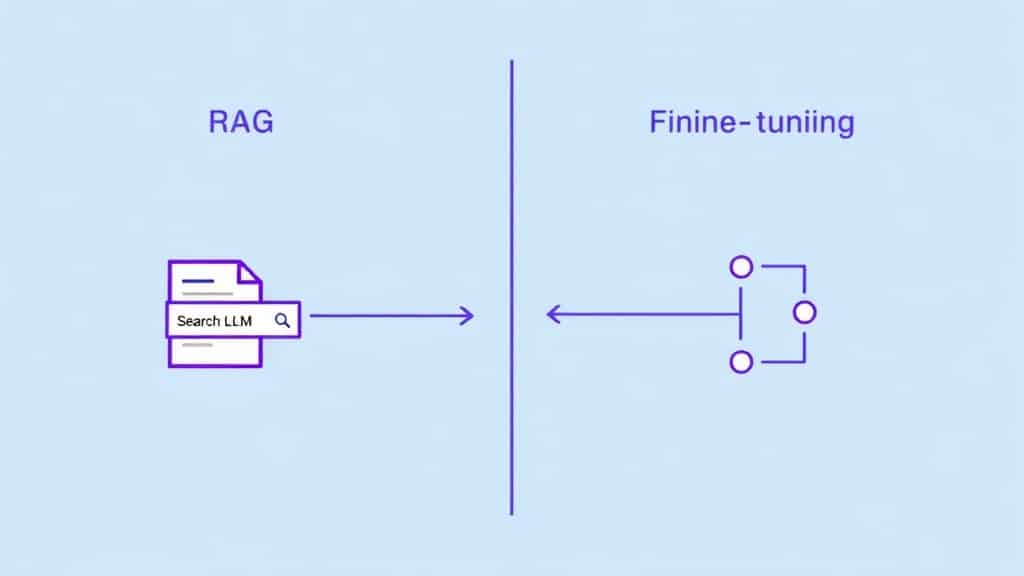
- RAG (Retrieval-Augmented Generation) retrieves relevant documents at query time and feeds them to the LLM — no model training needed.
- Fine-tuning trains the model weights on your data, changing the model’s behavior and ‘memory’ permanently.
- Knowledge problem (model doesn’t know your content)? Use RAG. Behavior problem (model doesn’t respond in your style/format)? Fine-tune.
- RAG is faster to implement, cheaper to maintain, and handles changing data better.
- The production standard in 2026: fine-tune for behavior + RAG for knowledge — use both together.
What RAG Actually Does
Consider this scenario: when a student asks your AI tutor “what’s the difference between variance and standard deviation?”, RAG does the following before the LLM ever sees the question:
- First, it converts the question to a vector embedding (a list of numbers representing meaning)
- It then searches your vector database for the most semantically similar chunks from your course materials
- Finally, it prepends those chunks to the prompt: “Here is relevant course content: [retrieved text]. Now answer: what’s the difference between variance and standard deviation?”
Crucially, the LLM never learned this content during training. Instead, it reads it fresh each time — much like the way you’d read a note before answering a question. That is precisely why RAG works brilliantly for knowledge-intensive applications: the knowledge lives in your database, rather than being baked into model weights.
| Dimension | RAG | Fine-Tuning |
|---|---|---|
| Data freshness | Real-time — update the database, done | Requires retraining (days + ₹10K+) |
| Knowledge base size | Millions of documents — no limit | Limited by context window and training data |
| Hallucination risk | Low (model references retrieved docs) | Higher (knowledge baked into weights can drift) |
| Implementation time | 1–2 weeks for a basic pipeline | 2–8 weeks including data prep |
| Behavior/style change | No effect | Deep and persistent |
| Interpretability | High — you can see what was retrieved | Black box |
| Monthly cost at scale | Storage + embedding API (₹2K–₹15K) | Training cost amortized + inference |
| Best for | Course content Q&A, product docs, FAQs | Consistent tone, structured output, task specialization |
The 5-Question Decision Framework
Ask these before picking an approach:
- Is this a knowledge problem or a behavior problem? “Model answers questions about competitor products” = knowledge problem (RAG). “Model refuses to follow output format” = behavior problem (fine-tune).
- How often does your data change? Course materials updated monthly? RAG handles this with a re-index. Fine-tuned weights are static until retrained.
- Do you have 500+ labeled examples? Fine-tuning on fewer than 200–300 examples routinely makes models worse, not better. If you don’t have the data, RAG is your only realistic option.
- What’s your latency budget? RAG adds 100–400ms for retrieval. Fine-tuned models run at base latency. For real-time autocomplete, fine-tuning wins.
- Do you need auditability? For regulated industries (EdTech with student data, healthcare), RAG’s “show your sources” capability is often legally important. Fine-tuned models can’t explain why they said what they said.
Start with RAG. Always. It’s faster, cheaper, and easier to improve. Add fine-tuning later, once you have production data, clear behavior gaps, and 500+ labeled examples. Don’t reverse this order.

Building a RAG Pipeline That Actually Works
The quality gap between a mediocre RAG and a good RAG is mostly about chunking and retrieval — not the LLM. Three things that matter most:
Chunking strategy: Splitting text at fixed character counts (naive chunking) breaks concepts mid-sentence and destroys retrieval quality. Use recursive text splitters that respect paragraph boundaries, or semantic chunking that groups related sentences together. This single change often improves answer quality by 20–30%.
Free 2026 Career Roadmap PDF
The exact SQL + Python + Power BI path our students use to land Rs. 8-15 LPA data roles. Free download.
Embedding model choice: text-embedding-3-small (OpenAI) is fast and cheap. BGE-M3 (open source) is often better for technical content. Always evaluate embeddings on your actual domain data before committing.
Reranking: Adding a reranker (Cohere Rerank or BGE Reranker) after the initial retrieval step consistently improves precision by 15–25%. Retrieve 20 candidates, rerank to top 5, pass to LLM. This is probably the highest-ROI optimization in a RAG pipeline.
Case Study: 91% Fewer Hallucinations
An online data science bootcamp deployed GPT-4o for student Q&A without any grounding. The model was confident and helpful — and wrong about course-specific details 34% of the time. It cited tools and libraries that weren’t in the curriculum. Students noticed and stopped trusting it.
The team built a RAG pipeline: 600 lecture transcripts, 40 project guides, 200 cheat sheets, all chunked with recursive splitting and indexed in Pinecone using text-embedding-3-small. Each query retrieves 10 chunks, reranked to top 4. They added a citation requirement to the system prompt: “Always cite the specific course material you’re referencing.”
Result: Hallucination rate dropped from 34% to 3%. Student trust recovered — average session time with the AI jumped from 4 minutes to 19 minutes. The platform eliminated 2 of 5 human support agents, saving ₹12 lakh per year. Setup time: 2 weeks.
Common Mistakes
- Fine-tuning on small datasets. The “minimum effective dose” for fine-tuning GPT-4o mini is around 300–500 high-quality examples. Below that, you’re more likely to make the model worse. If you have fewer, start with prompt engineering and RAG.
- Naive chunking. Character-count chunking splits content arbitrarily. Use
RecursiveCharacterTextSplitterwith chunk overlap, or semantic chunking if quality really matters. - No evaluation pipeline. You cannot know if your RAG is improving or degrading if you’re not measuring it. Set up RAGAS (faithfulness, answer relevancy, context precision) on a golden dataset of 100–200 real questions before you start optimizing.
FAQ
Can I use RAG and fine-tuning together?
Yes — this is the recommended production approach. Fine-tune to get consistent output format and tone; RAG to inject fresh knowledge. They solve different problems and complement each other.
How much does fine-tuning cost?
OpenAI fine-tuning on GPT-4o mini: roughly ₹0.66 per 1,000 training tokens. A dataset of 500 examples (avg 500 tokens each) = ~₹1,650 for one training run. But you’ll need multiple runs plus the time for data prep. Budget ₹15K–₹50K for a serious fine-tuning project.
What’s GraphRAG?
Microsoft’s extension of RAG that builds a knowledge graph from documents, enabling multi-hop reasoning (“find the connection between concept A in lecture 3 and concept B in lecture 7”). Meaningful improvement for complex Q&A, but significantly more setup work.
Which vector database should I use?
For getting started: Chroma (local, free, zero setup). For production: Qdrant (self-hostable, excellent performance) or Pinecone (fully managed). Avoid switching databases mid-project — the migration is painful.
The Short Version
If your LLM gives wrong answers about your specific domain: RAG. If it gives answers in the wrong tone, format, or style: fine-tune. If it does both: RAG for knowledge, then fine-tune for behavior once you have sufficient labeled data. In that order.
Learn to build RAG systems that actually work — join GrowAI
Live mentorship • Real projects • Placement support
Ready to start your career in data?
Book a free 1-on-1 counselling session with GrowAI. Personalised roadmap, zero pressure.

