

AWS vs GCP vs Azure: Which Cloud Platform Should Data Engineers Learn First?
Ask ten senior data engineers which cloud platform they recommend for beginners and you will get eleven different answers. That is not because the question is unanswerable — it is because the stakes are real and nobody wants to be wrong. Picking the wrong cloud platform for data engineers in 2026 costs you 6–12 months of reskilling time and certification spend. The market has not consolidated: AWS still leads with 31% market share, Google Cloud is the fastest-growing at 23% year-over-year, and Azure dominates in enterprise accounts tied to Microsoft’s ecosystem. Each has genuine strengths for data engineering work. This guide cuts through the noise and gives you a direct answer based on where you are in your career, what kind of data work you want to do, and where the job market is actually paying in 2026.
- AWS is the safest first choice for most data engineering beginners — widest job market, deepest service catalog, most learning resources.
- GCP is the best choice if you want to specialize in BigQuery-centric analytics or work in data-heavy startups and EdTech companies.
- Azure is the right choice if you are targeting enterprise roles at companies already running Microsoft workloads.
- The certification path matters: AWS Data Engineer Associate, Google Professional Data Engineer, and Azure DP-203 are the three credentials hiring managers actually check.
- You do not need to master all three clouds — go deep on one, then add a second after your first production deployment.
The State of Cloud Data Engineering in 2026
Cloud data engineering has undergone a structural shift over the past 24 months. The separation between data engineering and ML engineering is blurring — modern data platforms are expected to support both batch pipelines and real-time inference serving, often on the same infrastructure. That means the best cloud for data engineering in 2026 is increasingly evaluated not just on ETL tooling and warehouse performance, but on how well it integrates with ML platforms, streaming engines, and data governance frameworks.
AWS responded to this pressure by tightening integration between Glue, Redshift, SageMaker, and Lake Formation into what they now call the AWS Data and AI Stack. Google Cloud doubled down on BigQuery as the unified analytics and ML engine — BigQuery ML now supports LLM fine-tuning directly inside SQL queries, a genuinely remarkable capability. Azure leaned into its Fabric platform, which consolidates Data Factory, Synapse, Power BI, and Purview into a single governance layer that enterprise IT teams have adopted at high velocity.
Job market data from LinkedIn and Glassdoor as of Q1 2026 shows AWS data engineering roles outnumbering GCP roles roughly 2.8:1 in North America. In Europe, that ratio is closer to 2:1. In Southeast Asia and India, GCP and AWS are near parity for new data engineering job postings. Azure roles skew heavily toward enterprise and government sectors globally. If you are optimizing purely for job volume, AWS wins. If you are targeting specific verticals or geographies, the calculus shifts.
A Structured Learning Path: From Zero to Certified Data Engineer
Regardless of which cloud you choose, the sequence of what to learn stays consistent. Here is the framework.
- Choose your cloud provider. Make this decision based on three factors: where your current employer or target employer runs infrastructure, what your existing technical background maps to (SQL-heavy background favors GCP, Python-heavy background favors AWS), and where your local job market shows demand. Do not pick based on which has the flashiest marketing.
- Learn core storage and compute. Every cloud data engineering stack starts with object storage (S3, GCS, ADLS Gen2) and virtual compute (EC2, Compute Engine, Azure VMs). Spend 3–4 weeks here. Build something real — ingest a public dataset, store it, query it. Do not just watch tutorials.
- Master your cloud’s data warehouse. Redshift for AWS, BigQuery for GCP, Synapse Analytics for Azure. This is the highest-leverage skill in cloud data engineering. Employers care more about your warehouse expertise than almost anything else. Understand partitioning, clustering, query optimization, cost management, and incremental loading patterns. Plan 6–8 weeks.
- Learn orchestration. Apache Airflow is the default — all three clouds offer managed Airflow services (MWAA on AWS, Cloud Composer on GCP, managed Airflow on Azure). Learn DAG design, dependency management, and failure handling. If your target environment uses dbt, layer that in here — dbt has become the de facto transformation layer across all three clouds.
- Build a real pipeline project. Take a public dataset — government open data, educational records, sports statistics — and build a full pipeline: ingest, store raw, transform, load to warehouse, build a simple dashboard. Document it on GitHub. This is what hiring managers look at, not your certificate score.
- Get certified. Certifications signal baseline competency. Prioritize: AWS Data Engineer Associate (DEA-C01), Google Professional Data Engineer, or Azure DP-203. Budget 4–6 weeks of focused study. Use the official practice exams from the vendor — they are the most accurate signal of real exam difficulty.
Text Flowchart:
START → [Choose cloud provider] → [Learn core storage + compute] → [Master data warehouse] → [Learn orchestration] → [Build pipeline project] → [Get certified] → END
AWS vs GCP vs Azure: Deep Dive by Use Case
For LMS and EdTech Platforms: Google Cloud’s BigQuery has become the go-to analytics backend for mid-to-large EdTech companies. The reasons are practical: BigQuery’s serverless pricing model eliminates capacity planning for bursty academic calendar workloads (enrollment spikes in August and January are brutal on provisioned clusters), and BigQuery ML lets product teams run predictive models directly against student event data without moving data to a separate ML platform. Coursera, Duolingo, and several large LMS vendors run significant portions of their analytics on BigQuery. GCP is the natural home for data engineers targeting the EdTech sector.
For Data-Heavy Startups and Scale-Ups: AWS wins on ecosystem breadth. When a startup’s stack spans Kafka on EC2, a data lake on S3, transformations in Glue, a warehouse in Redshift, and ML in SageMaker, having everything in one ecosystem with unified IAM, VPC, and billing reduces operational complexity at the exact moment that operational complexity is the enemy. The AWS data engineering community is the largest, which means Stack Overflow answers, open-source tooling support, and hiring pool depth all skew AWS.
For Enterprise and Government: Azure’s dominance here is not accidental — it flows directly from Microsoft’s existing relationships at the IT procurement level. Organizations running Active Directory, Office 365, Teams, and Dynamics 365 find Azure data services integrate with dramatically less friction. Azure Data Factory’s connector catalog (900+ native connectors as of 2026) and Microsoft Fabric’s unified governance model are genuinely differentiating capabilities for enterprise data teams managing complex compliance requirements. If your target employer is a bank, healthcare system, government agency, or large CPG company, learning Azure first is the highest-ROI move.
For AI/ML-Heavy Data Pipelines: GCP has the strongest native integration between data engineering and ML workloads — BigQuery ML, Vertex AI, and Dataflow for streaming pipelines form a cohesive stack. AWS SageMaker is more mature as a standalone MLOps platform, but the integration between Glue/Redshift and SageMaker requires more plumbing. Azure ML is strong for enterprise teams but lacks the SQL-native ML experience BigQuery offers. If your data engineering work is tightly coupled with model training and serving, GCP gives you the smoothest workflow.
Platform Comparison: AWS vs GCP vs Azure for Data Engineering
| Dimension | AWS | GCP | Azure |
|---|---|---|---|
| Market Share (2026) | ~31% | ~13% | ~25% |
| Core Data Services | S3, Glue, Redshift, Kinesis, MWAA | GCS, Dataflow, BigQuery, Pub/Sub, Composer | ADLS, Data Factory, Synapse, Event Hubs, Fabric |
| ML Integration | SageMaker (strong, separate) | BigQuery ML + Vertex AI (tightly native) | Azure ML + Fabric (enterprise focus) |
| Data Warehouse | Redshift (provisioned + serverless) | BigQuery (fully serverless) | Synapse Analytics |
| Certification Path | DEA-C01 (Data Engineer Associate) | Professional Data Engineer | DP-203 (Data Engineering) |
| Pricing Model | Complex; reserved instances save 40–60% | Slots or on-demand; predictable for analytics | Hybrid; EA agreements common |
| Best For Data Engineering | General-purpose; largest job market | EdTech, analytics-first, ML pipelines | Enterprise, government, Microsoft shops |
Key Insights
- AWS’s biggest data engineering advantage is ecosystem gravity — not any single service. The combination of S3’s ubiquity, Glue’s serverless ETL, and Redshift’s mature optimization tooling gives you a complete pipeline stack with fewer integration decisions to make.
- BigQuery’s serverless model is genuinely different from Redshift and Synapse — there is no cluster to size, no warehouse to pause and resume, and pricing is per-byte-scanned for ad hoc queries. For bursty workloads like EdTech semester cycles, this is a real operational advantage.
- Azure Fabric is the most ambitious product release of 2025–2026 — consolidating six previously separate services into one governance-unified platform. Enterprise data teams evaluating Azure today should evaluate Fabric first, not Synapse standalone.
- dbt has become cloud-agnostic infrastructure — it runs equally well on all three clouds and is now the dominant transformation framework regardless of which warehouse you use. Learn dbt early and it travels with you across platforms.
- The certification market has shifted toward specialization — the generic cloud practitioner certifications carry less hiring signal than the data-specific ones (DEA-C01, Professional Data Engineer, DP-203). Invest in the specialist cert from the start.
- Multi-cloud data engineering is a real job category in 2026, particularly in large enterprises using Snowflake or Databricks as a cloud-neutral layer on top of all three clouds. Once you have gone deep on one cloud, the second comes significantly faster.
Case Study: How a US EdTech Company Migrated from On-Prem to GCP and Reduced Query Time by 74%
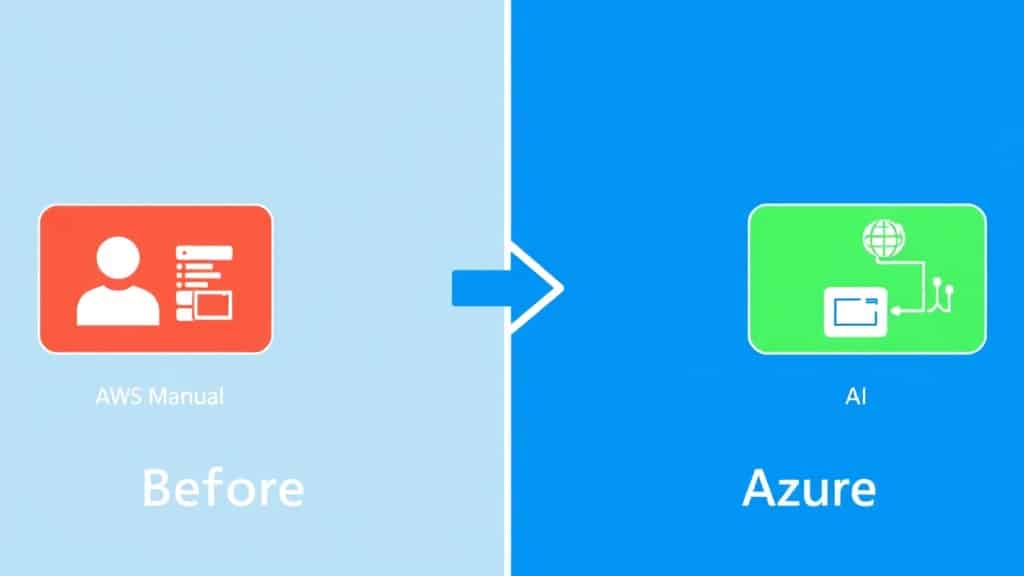
Organization: A US-based online skills training platform with 280,000 active learners and a data team of four — two data engineers, one analyst, and one data scientist.
Before: The team ran a self-managed Hadoop cluster in a co-location facility. Nightly ETL jobs took 4–6 hours to complete. Ad hoc queries on the analytical layer took 8–45 minutes depending on data volume. Infrastructure maintenance consumed roughly 30% of both data engineers’ time. Scaling for enrollment spikes — particularly around annual subscription renewal campaigns — required manual cluster resizing with 48-hour lead time. Total annual infrastructure cost: $340,000 including hardware depreciation, colocation fees, and staff time.
After: The team migrated to GCP over a 14-week project. Raw data lands in Google Cloud Storage via Pub/Sub event streams from the LMS. Dataflow handles streaming transformations and writes to BigQuery. dbt Cloud manages all analytical transformations as versioned SQL. The data scientist runs course recommendation models directly in BigQuery ML without moving data to a separate environment. Infrastructure maintenance time dropped from 30% of engineer time to under 5%.
Result: Ad hoc query times dropped from an average of 22 minutes to 5.7 minutes — a 74% reduction. Nightly pipeline completion time went from 4–6 hours to 47 minutes. Annual cloud spend is $118,000, representing a 65% cost reduction versus the on-prem setup. The team used the freed capacity to build two new data products — a learner engagement score and a course completion predictor — that they could not have prioritized under the old infrastructure model. The two data engineers are both now GCP Professional Data Engineer certified.
Common Mistakes Data Engineers Make When Choosing and Learning a Cloud Platform
Mistake 1: Choosing a cloud platform based on which has the best tutorials, not where the jobs are
Why it happens: GCP and Azure have invested heavily in high-quality free learning content, which skews learner perception of their market presence. Beginners assume tutorial quality correlates with job market demand.
The fix: Before committing to a learning path, spend 30 minutes on LinkedIn Jobs and Indeed filtering for “data engineer” in your target geography. Count the job postings by cloud keyword. Make your decision based on that data, not on which platform has a nicer UI for its certification prep course.
Mistake 2: Learning cloud services in isolation instead of building pipelines
Why it happens: Most certification prep courses teach services as individual modules — S3, then Glue, then Redshift — without ever connecting them into an actual data pipeline. Students pass the exam but cannot build anything real.
The fix: After every service module, build a mini-project that connects that service to something you already know. By the time you finish your learning path, you should have a portfolio of 3–4 working pipelines, not just a certificate.
Mistake 3: Ignoring cost management until the first surprise bill
Why it happens: Cloud pricing is genuinely complex, and beginners tend to defer cost understanding until it becomes urgent — which usually means a $400 bill for a test project that ran longer than expected.
The fix: Set up billing alerts on day one. On AWS, set a CloudWatch billing alarm at $10 and $50. On GCP, set a budget alert in the Billing console. On Azure, use Cost Management + Billing alerts. Treat cost management as a core data engineering skill, not an afterthought.
Mistake 4: Getting certified before building anything in production
Why it happens: Certification feels like a tangible goal. Building a real project feels ambiguous. So people study for the exam, pass it, and then struggle in interviews because they cannot discuss actual architecture decisions they have made.
The fix: Build your pipeline project before you sit the certification exam, not after. The project work will surface gaps in your knowledge that the practice exams will not. Interviewers consistently report that candidates with project experience but no cert outperform certified candidates with no project experience.
Frequently Asked Questions About Cloud Platforms for Data Engineers

Q: Which cloud platform is best for data engineers to learn first in 2026?
AWS is the safest default for most beginners due to job market volume and ecosystem breadth. GCP is the best choice for EdTech and analytics-heavy roles. Azure leads in enterprise and Microsoft-stack environments. Match your choice to your target employer type and geography, not to abstract platform rankings.
Q: Is the AWS Data Engineer Associate certification worth it in 2026?
Yes — the DEA-C01 launched in 2024 and has quickly become a recognized hiring signal. It covers Glue, Redshift, Kinesis, and Lake Formation at a practical level. Study time is typically 6–8 weeks for candidates with Python and SQL backgrounds. Pair it with a portfolio project for maximum hiring impact.
Q: How does Google BigQuery compare to Amazon Redshift for data engineering work?
BigQuery is fully serverless and better for bursty, unpredictable query volumes. Redshift offers more control over compute configuration and performs well for consistently high query loads. Both support dbt natively. BigQuery ML’s SQL-native ML is a significant differentiator if your work intersects with model development.
Q: Can a data engineer learn all three clouds simultaneously?
Not effectively. The service depth required for production work on any single cloud takes 6–12 months to develop. Learn one cloud to a deployable level first, then add a second. The second cloud will take 30–40% less time because the underlying concepts — object storage, managed compute, warehouse optimization, IAM — transfer directly.
Q: What is the best cloud data engineering certification for getting hired in 2026?
AWS DEA-C01 has the widest recognition given AWS job market share. Google Professional Data Engineer is highly valued for analytics and EdTech roles. Azure DP-203 is the right choice for enterprise and Microsoft-ecosystem targets. All three are respected — pick the one aligned with your target job type, not the easiest to pass.
Making the Call — and Building the Career That Comes After
The cloud platform debate is not going away — but the urgency to pick the “right” one is often overstated. The fundamentals of data engineering are cloud-agnostic: understand your data model, design pipelines for failure, optimize for cost and performance together, document your work, and monitor everything. A data engineer who has shipped pipelines to production on one cloud can learn a second in months, not years.
What matters more than platform choice is whether you build things. Real pipelines, real data, real trade-offs. The data engineers getting hired in 2026 are not the ones with the longest certification list — they are the ones who can explain what broke in production and what they did to fix it. Start there. Get to production on one cloud, earn your specialist cert, and then expand. The market will reward you for depth before it rewards you for breadth.
Book a Free Demo at GrowAI
Free 2026 Career Roadmap PDF
The exact SQL + Python + Power BI path our students use to land Rs. 8-15 LPA data roles. Free download.
Ready to start your career in data?
Book a free 1-on-1 counselling session with GrowAI. Personalised roadmap, zero pressure.

