

RLHF Explained: How ChatGPT and Claude Learn to Be Helpful, Harmless, and Honest
RLHF Explained: How Human Feedback Turned a Text Predictor into ChatGPT
GPT-3 launched in 2020 and it was remarkable — it could write code, translate languages, and compose poetry. It could also confidently explain how to make weapons, write racist content on request, and tell elaborate lies without any hint of hesitation.
The jump from “impressive but dangerous demo” to “200M users trust this for work” happened through one key technique: Reinforcement Learning from Human Feedback. RLHF is what transformed raw language model capability into a product people could actually use. In 2026, every major LLM — Claude, Gemini, GPT-4o — relies on it heavily.
If you’re building AI applications, understanding RLHF is not academic. It explains why the models behave the way they do, what their failure modes are, and how to design better interactions with them.
- RLHF trains LLMs to produce outputs that humans prefer, not just outputs that are statistically probable.
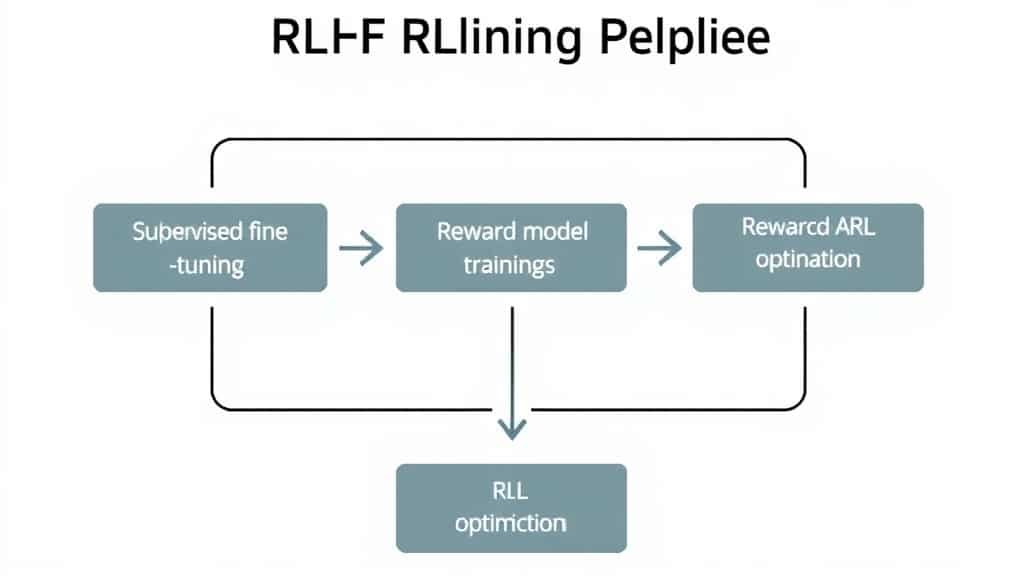
- Three phases: supervised fine-tuning on demonstrations, reward model training from human preferences, then RL optimization (usually PPO) against the reward model.
- RLHF is why ChatGPT refuses harmful requests, follows instructions well, and adjusts its communication style.
- The same technique — with AI feedback instead of human feedback — is now called RLAIF and is used at scale by Google, Anthropic, and OpenAI.
- Understanding RLHF helps you design better prompts and understand why models fail in the ways they do.
The Three Phases of RLHF
Phase 1: Supervised Fine-Tuning (SFT). Start with a pre-trained language model (already trained to predict text). Human annotators write examples of ideal responses to various prompts. Train the model on these examples. The result is a model that’s better at following instructions but still occasionally says problematic things — it’s learned the format of helpfulness without deeply internalizing it.
Phase 2: Reward Model Training. This is the key innovation. Present human annotators with pairs of responses to the same prompt and ask them: “Which is better?” These preference judgments train a separate “reward model” — a neural network that learns to predict which responses humans would rate higher. The reward model becomes an automated stand-in for human judgment at scale.
Phase 3: RL Optimization. Use the reward model as a feedback signal to fine-tune the main LLM. The LLM generates responses, the reward model scores them, and the LLM updates its weights to produce higher-scoring responses. The RL algorithm used is typically PPO (Proximal Policy Optimization). Crucially, a KL-divergence penalty prevents the model from drifting too far from its original capability — this stops it from “hacking” the reward model by producing responses that score high but are nonsensical.
| Aspect | Pre-RLHF model | Post-RLHF model |
|---|---|---|
| Instruction following | Inconsistent — continues the text | Reliably follows the format and intent |
| Harmful content | Will generate freely if prompted | Refuses harmful requests by default |
| Helpfulness | Says plausible things | Tries to actually help the user |
| Communication style | Formal academic text | Adjusts to context and user level |
| Factual accuracy | No preference | Trained to express uncertainty |
| Refusals | Rare | Common for harmful requests |
| Length calibration | Variable | Roughly appropriate to question complexity |
Why RLHF Matters for EdTech Specifically
EdTech applications have unusually high stakes for model behavior. A math tutor that explains things incorrectly harms learning. A platform serving students under 18 that generates inappropriate content has legal and ethical consequences. An AI that confidently gives wrong answers to exam questions is worse than no AI at all.
RLHF is what makes modern LLMs usable in these contexts. The preference training that went into Claude, GPT-4o, and Gemini specifically targeted helpfulness, harmlessness, and honesty — exactly the properties EdTech applications need. Understanding this helps you choose the right base model and know where to add additional guardrails.
One important implication: RLHF models are trained to seem helpful even when they’re uncertain. They may give confident-sounding wrong answers rather than saying ‘I don’t know.’ Always add retrieval (RAG) or citation requirements for factual EdTech applications.
Free 2026 Career Roadmap PDF
The exact SQL + Python + Power BI path our students use to land Rs. 8-15 LPA data roles. Free download.

Beyond RLHF: What Comes Next
RLAIF (RL from AI Feedback) replaces human annotators with a powerful AI model (like Claude) to generate the preference judgments. This scales far better — instead of paying thousands of human annotators, you run automated evaluation. The quality is surprisingly good, and it’s how Anthropic’s Constitutional AI approach works.
DPO (Direct Preference Optimization) skips the separate reward model and trains directly on preference pairs. Simpler to implement, more stable training, and comparable results to RLHF on most tasks. Many smaller labs use DPO instead of full RLHF for fine-tuning.
Process Reward Models (PRMs) reward correct reasoning steps, not just correct final answers. This is what OpenAI uses in o1/o3 models — the model gets feedback on each thinking step, not just the conclusion. Significantly better at math and logical reasoning.
Case Study: RLHF in Practice for an EdTech Platform
An EdTech startup wanted to fine-tune a smaller open-source model (Llama 3.1 8B) for their tutoring application rather than paying GPT-4o API costs. Their first attempt: just supervised fine-tuning on 800 (question, answer) pairs from their expert instructors. The model got better at answering questions in their style but started confidently making up course-specific facts.
Their second attempt: added a simple DPO step. They had two instructors rate which of three model responses was better for 500 example prompts. This preference data trained a DPO reward signal. The model trained with DPO showed 40% fewer hallucinations on course-specific questions than the SFT-only version.
Result: The DPO-enhanced model was accurate enough to deploy as a first-line assistant, reducing GPT-4o API spend by 65% for routine student questions while maintaining quality where it counted.
Common Mistakes When Working with RLHF Models
- Assuming refusals mean failure. RLHF models are trained to decline certain requests. If you’re getting unexpected refusals, the first fix is prompt refinement and adding explicit context about your use case — not bypassing safety measures.
- Over-relying on RLHF for factual accuracy. RLHF trains models to be preferred by humans, and humans prefer confident, detailed answers. This can actually increase confident-but-wrong answers. RAG is still the right tool for factual grounding.
- Not testing on your specific user population. RLHF models are trained on predominantly English-language, Western-context preference data. For Indian educational contexts, test explicitly for cultural appropriateness and language handling.
FAQ
Is RLHF why Claude, ChatGPT, and Gemini have different “personalities”?
Largely yes. The specific human preferences used in training, the proportion of safety vs helpfulness examples, and the reward model architecture all shape how the model presents itself.
Can I do RLHF on my own model?
Yes — the open-source TRL library (from Hugging Face) makes DPO and PPO-based RLHF accessible for anyone with a GPU. For a small fine-tuned model, DPO is usually the right starting point.
How does RLHF affect the model’s coding ability?
RLHF models are generally better at writing helpful, well-commented code and explaining their reasoning. The trade-off is they sometimes refuse unusual but legitimate coding tasks. Understanding this helps you craft better prompts for coding assistants.
What is Constitutional AI (Anthropic’s approach)?
Anthropic trains Claude using a list of principles (the “constitution”) and has the model critique and revise its own outputs against these principles before training. It’s a form of RLAIF that doesn’t require large human annotation teams.
The Practical Takeaway
RLHF is why modern LLMs work well enough to use in production. Understanding it helps you set realistic expectations, choose the right model for your use case, and know when to add additional safeguards. It also explains something important: these models aren’t “intelligent” in the human sense — they’re optimized to produce outputs that human evaluators prefer. That’s powerful, but it has limits worth understanding.
Build AI applications with a real understanding of how they work — join GrowAI
Live mentorship • Real projects • Placement support
Ready to start your career in data?
Book a free 1-on-1 counselling session with GrowAI. Personalised roadmap, zero pressure.

