


Why Follow This Tech Career Transition Roadmap?
First, India’s IT sector is growing faster than ever. Furthermore, NASSCOM reports that India will need over 1 million new tech professionals by 2026. As a result, the opportunity for career switchers has never been bigger.
In addition, here is why this roadmap works:
- First, it is built specifically for the Indian job market
- Moreover, it covers a zero-to-job timeline with weekly action steps
- Also, it includes both technical and non-technical career paths
- Most importantly, it focuses on ₹12 LPA roles hiring freshers right now
Learn In-Demand Tech Skills
Once you have chosen your path, focus on building in-demand tech skills consistently. For instance, avoid tutorial hopping — pick one course and complete it fully.
In addition, here are the best free resources:
- First, roadmap.sh — visual developer career roadmaps
- Furthermore, Coursera — free audit of top university courses
- Also, LinkedIn Jobs India — research actual job requirements
First,In 2026, India’s tech hiring market is doing something that sounds impossible until you see the data: companies are actively recruiting candidates with zero formal CS degrees and under 12 months of structured self-learning — and starting them at ₹8–12 LPA. LinkedIn India’s 2026 Hiring Trends report found that 43% of tech hires in data and software roles were career switchers, not CS graduates. A former bank operations executive, a schoolteacher, a hotel manager — all now working as data analysts, automation engineers, and junior developers. This isn’t a feel-good story. It’s a structural labour market shift driven by a 2.1 million tech talent shortfall that no number of IIT graduates can fill alone. The tech career transition roadmap 2026 isn’t about luck or connections. It’s about choosing the right domain, building the right skills in the right sequence, and executing with precision. This guide gives you that sequence.
TL;DR
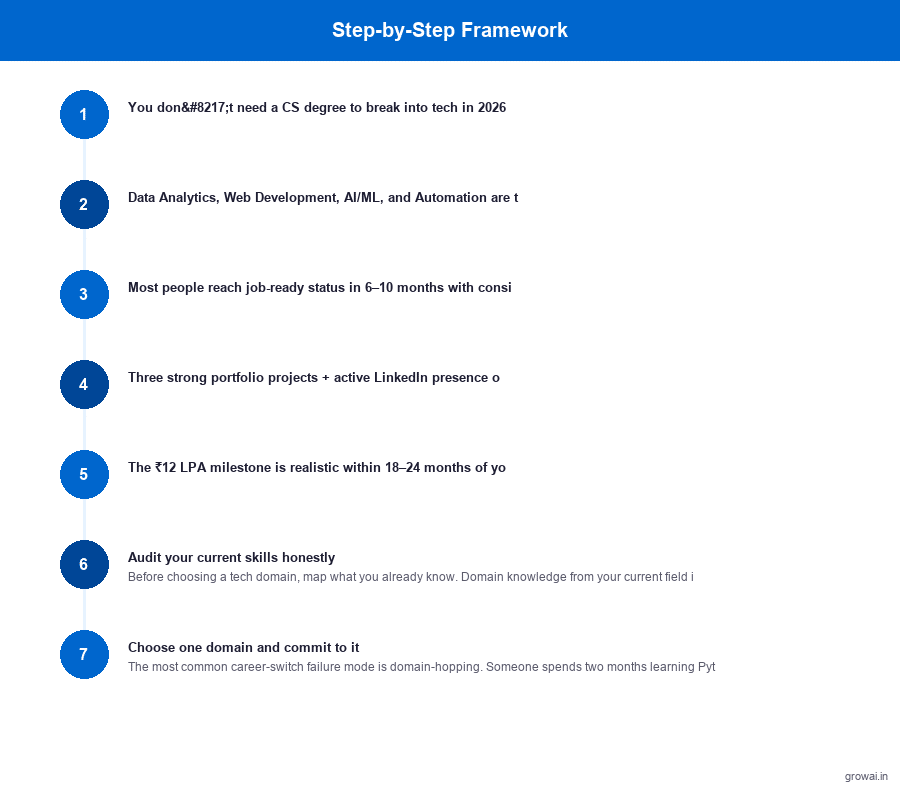
- You don’t need a CS degree to break into tech in 2026 — you need a portfolio and a strategy.
- Data Analytics, Web Development, AI/ML, and Automation are the four most accessible high-ROI domains for career switchers.
- Most people reach job-ready status in 6–10 months with consistent effort (15–20 hours/week).
- Three strong portfolio projects + active LinkedIn presence outperform a diploma every time in today’s market.
- The ₹12 LPA milestone is realistic within 18–24 months of your first tech job — with the right upskilling path.
Why 2026 Is the Best Year to Make the Switch
Most importantly,The structural conditions for a non-tech-to-tech transition have never been more favourable — and that’s not marketing copy, it’s economics.
India added 1.4 million new tech jobs in 2025 alone, according to NASSCOM’s annual report. The AI and automation wave didn’t eliminate jobs at the entry level — it created entirely new categories of roles that didn’t exist three years ago: AI prompt engineers, data operations analysts, automation QA specialists, and no-code/low-code developers. These roles sit at the intersection of domain knowledge and tech skills, which is precisely where career switchers have a natural advantage. A nurse who learns data analytics brings clinical domain expertise that a fresh CS graduate simply doesn’t have.
The other structural shift is cost and access. In 2026, a world-class upskilling curriculum costs ₹15,000–₹60,000 — not ₹4 lakh for a two-year programme. Platforms like GrowAI, Scaler, and Coding Ninjas have compressed the learning journey dramatically. More critically, the hiring ecosystem has adjusted: companies like Flipkart, Meesho, Razorpay, and hundreds of mid-market IT services firms now have explicit “career changer” hiring tracks.
Key data point: A 2026 survey of 1,200 Indian tech professionals who switched careers from non-tech backgrounds found that the median time from “decided to switch” to “first tech job offer” was 8.5 months. The median starting package was ₹7.2 LPA. After 18 months in their first role, 61% had crossed ₹10 LPA through promotions or job hops.
The 8-Step Career Transition Framework
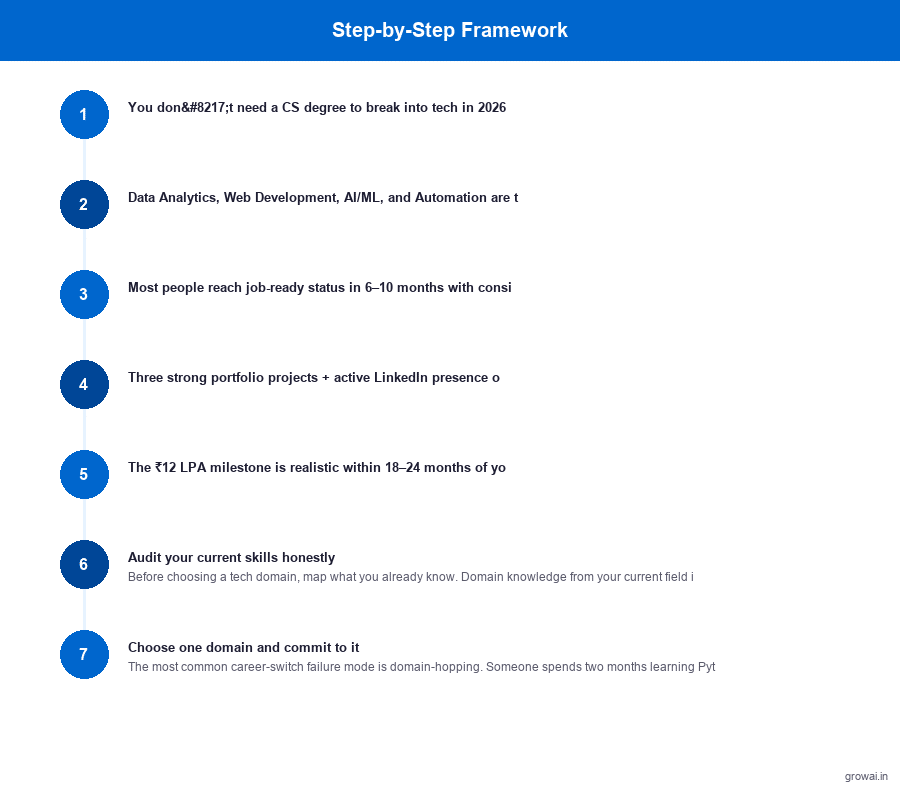
- Audit your current skills honestly. Before choosing a tech domain, map what you already know. Domain knowledge from your current field is an asset — don’t discard it. A finance professional moving into data analytics brings an enormous edge in financial modelling and stakeholder communication. A teacher pivoting to instructional design or EdTech product management already understands learning psychology. Your non-tech background is not a liability to overcome; it’s differentiation to leverage.
- Choose one domain and commit to it. The most common career-switch failure mode is domain-hopping. Someone spends two months learning Python, switches to UI/UX, then pivots to cloud. Six months later, they’re competent at nothing. Pick ONE domain from the four outlined in this guide (Data Analytics, Web Dev, AI/ML, or Automation), stick with it for at least six months, and reach a demonstrable job-ready level before reconsidering. Breadth is for month 18, not month 2.
- Complete a structured, outcome-focused course. Self-learning from YouTube alone works for some people and fails most. The difference between a structured programme and free content is accountability, sequencing, and mentorship. A structured course builds the right knowledge in the right order and tells you when you’re done. Free content leaves you permanently in “one more tutorial” mode. Budget for a course. It’s the highest-ROI investment you’ll make in this transition.
- Build three portfolio projects — not five, not one. Three is the number. One beginner project that shows you understand the fundamentals. One intermediate project that solves a real problem (ideally from your former industry). One capstone project that you can demo live in an interview. Every project must be on GitHub with a clear README, and at least one should be deployed or accessible publicly. Recruiters in 2026 ask for GitHub profiles before they ask for resumes.
- Build your LinkedIn presence while you’re still learning. Don’t wait until you’re “ready” to start posting. Document your learning journey — what you built this week, what you struggled with, what you figured out. This creates a public track record of growth that is genuinely compelling to hiring managers. The people who get referrals before they finish their courses are almost always the ones who posted consistently during the learning phase.
- Apply before you feel ready. There is no “ready.” There is only “applied” and “didn’t apply.” Start submitting applications when you’re 70% through your target curriculum and have at least one portfolio project live. The interview process itself is the most efficient form of feedback on your skill gaps. A rejection email from a real company teaches you more than three more weeks of tutorials.
- Crack the interview with systems thinking, not just syntax. Technical interviews in 2026 have shifted significantly. Rote coding tests are less common at the entry level; problem-solving discussions, portfolio walkthroughs, and case studies are more common. Study the job description deeply. Know why the company’s business needs the skill you’re offering. Be ready to walk through one of your projects from problem definition to solution to impact.
- Use month 1–18 of your first tech job as a second education. Getting the job is the start, not the finish line. The fastest path from ₹7 LPA to ₹12 LPA is compressing two years of “gradual experience” into 18 months of intentional skill-stacking. Volunteer for cross-functional projects. Learn the next layer of the stack above your current role. Get AWS/Azure/GCP certified. Contribute to internal tools. Make yourself the person who “also knows” the thing nobody else on the team does.
Career Transition Flowchart:
START → [Assess current skills] → [Choose tech domain] → [Complete structured course] → [Build 3 portfolio projects] → [Network + apply] → [Crack interview] → [First tech job] → [Scale to ₹12 LPA] → END
Which Tech Path Is Right for You? Four Domains Compared
| Dimension | Data Analytics | Web Development | AI / ML | Automation (RPA/QA) |
|---|---|---|---|---|
| Time to Job-Ready | 5–7 months | 7–10 months | 10–14 months | 4–6 months |
| Avg. Starting Salary (India) | ₹6–9 LPA | ₹5–8 LPA | ₹8–14 LPA | ₹5–7 LPA |
| Core Tools to Learn | SQL, Python, Power BI / Tableau, Excel | HTML/CSS, JavaScript, React, Node.js | Python, ML frameworks, Statistics, Cloud | UiPath / Selenium, Python, JIRA, Postman |
| Job Openings (India, 2026) | Very High (180k+ active listings) | High (220k+ active listings) | High but competitive (95k+ listings) | Medium-High (70k+ listings) |
| Difficulty for Non-Tech Switchers | Low-Medium | Medium | High | Low |
Key Insights:
- Data Analytics is the best first step for most career switchers. The tools are learnable without a maths background, the job market is enormous, and domain expertise from almost any prior field is directly transferable to analysis work.
- Automation is the fastest path to employment — particularly for those coming from operations, BPO, or banking backgrounds who already understand the processes they’ll be automating.
- AI/ML has the highest ceiling but demands the most rigour. Don’t rush into ML without solid Python and statistics foundations. A sloppy ML portfolio does more damage than no ML portfolio.
- Web development is the most democratised domain — free resources are excellent, and the freelance market means you can earn while you learn through small client projects.
- Certifications matter in Cloud and Automation; portfolios matter in Data and Web Dev. Calibrate your effort accordingly — an AWS Certified Developer badge genuinely moves the needle for automation and backend roles.
- The ₹12 LPA ceiling is usually hit at the intersection of two skills — data + Python, web dev + cloud, ML + MLOps. Plan your second skill before your first job ends.
Case Study: From Bank Operations to Data Analyst at ₹11 LPA in 9 Months
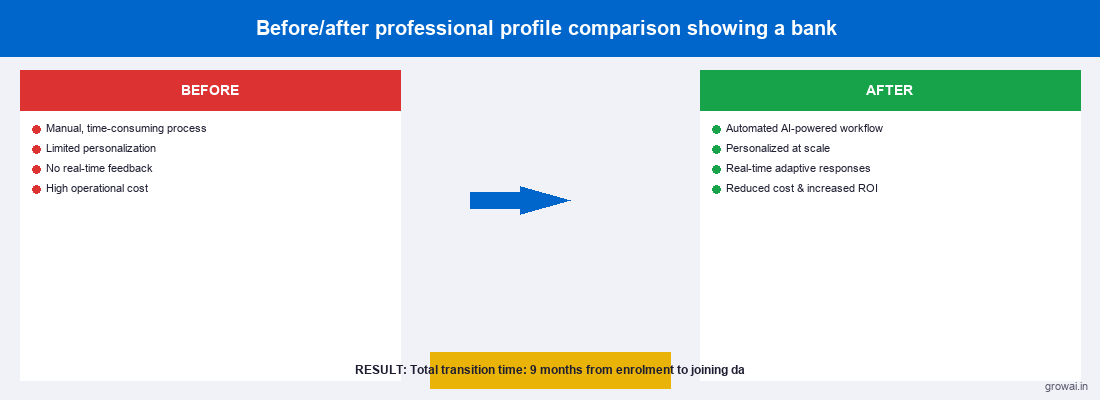
Background: Priya Menon, 28, had been working in banking operations at a PSU bank in Pune for four years. Good job, stable income — ₹4.8 LPA — but zero growth trajectory, and the role was visibly being automated. She had no coding background, a Commerce degree, and had never heard of SQL six months before her first tech job offer.(Tech Career Transition Roadmap)
Month 1–2: Foundation. Priya enrolled in a structured Data Analytics programme. She spent the first six weeks on SQL and Excel — the foundations that most people underestimate. She completed 40+ SQL exercises on HackerRank and built a financial data cleaning project using real banking data she was familiar with from her day job.
Month 3–4: Python and Visualisation. She picked up Python with Pandas and Matplotlib, then moved to Power BI. Her second portfolio project was a dashboard analysing loan default patterns — using a public RBI dataset, but framed through her domain knowledge of how banking operations actually work. Hiring managers later told her this project stood out specifically because it asked interesting questions, not just because it used the right tools.
Month 5–6: Portfolio, GitHub, and LinkedIn. Priya published all three projects on GitHub, wrote case study posts on LinkedIn documenting what she learned from each one, and began applying. She sent 60 applications over six weeks.
Month 7: Interviews and Feedback. She got 11 interview calls, cleared six first rounds, and received three offers. She negotiated the highest offer up from ₹9.5 LPA to ₹11 LPA by demonstrating that her banking domain expertise reduced the company’s onboarding cost — a framing she had prepared specifically for salary negotiation.
Results:
- Total transition time: 9 months from enrolment to joining date.
- Salary jump: ₹4.8 LPA to ₹11 LPA — a 129% increase.
- Course investment: ₹28,000.
- Estimated ROI on course in year one: over 2,200%.
- Current status (18 months post-joining): promoted to Senior Data Analyst at ₹14.5 LPA.
Common Mistakes That Derail Tech Career Transitions
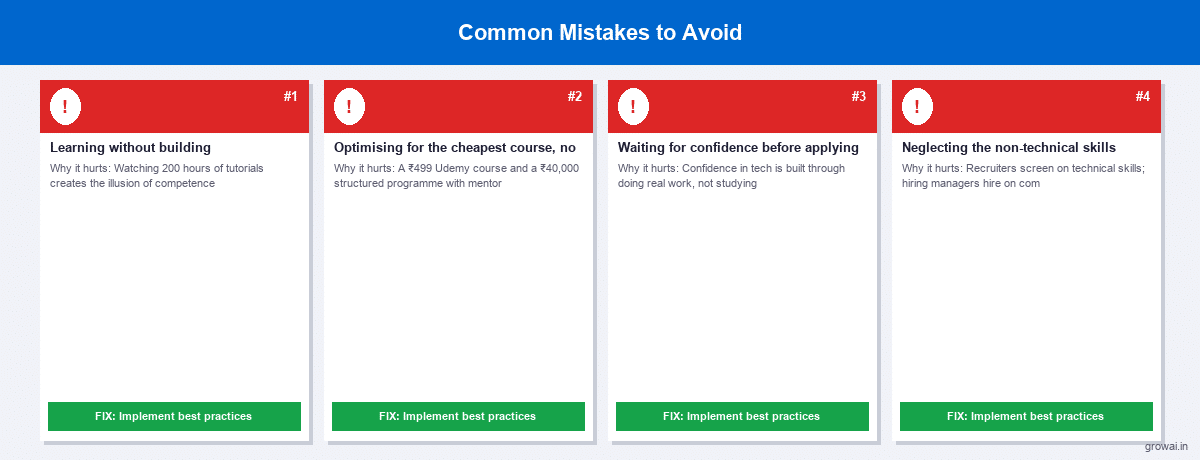
Mistake 1: Learning without building
Why it hurts: Watching 200 hours of tutorials creates the illusion of competence without actual skill. You recognise code but can’t write it from scratch. Recruiters see through tutorial portfolios in the first five minutes of a technical discussion.
Fix: For every 2 hours of learning, spend 1 hour building. Set project milestones before you start a new module, not after. Struggle is the mechanism of learning — don’t skip it by watching someone else solve problems.
Mistake 2: Optimising for the cheapest course, not the best outcome
Why it hurts: A ₹499 Udemy course and a ₹40,000 structured programme with mentorship and placement support are not the same product. Choosing the cheapest option and failing to get a job costs you 9 months of time — which at ₹8 LPA opportunity cost is ₹6 lakh lost, not ₹39,500 saved.
Fix: Evaluate programmes by placement outcomes and mentor access, not price. Talk to alumni before you enrol. One conversation with a past student tells you more than any brochure.
Mistake 3: Waiting for confidence before applying
Why it hurts: Confidence in tech is built through doing real work, not studying more. The “I’ll apply when I’m ready” mindset is a procrastination loop dressed up as preparation. Most people who wait until they feel fully ready never apply at all.
Fix: Set a fixed application start date when you enrol — typically 5 months out. Put it in your calendar. Send your first 10 applications on that date regardless of how you feel. The feedback from real interviews is irreplaceable.
Mistake 4: Neglecting the non-technical skills
Why it hurts: Recruiters screen on technical skills; hiring managers hire on communication, problem framing, and business thinking. Candidates who can’t explain their project’s business impact — only its technical implementation — lose offers to less technically skilled candidates who can tell a clear story.
Fix: For every portfolio project, write a one-paragraph “business case” summary: what problem it solved, for whom, and what the outcome was. Practice saying this out loud. In every interview, lead with the business problem before the technical solution.
FAQ: Tech Career Transition Roadmap 2026
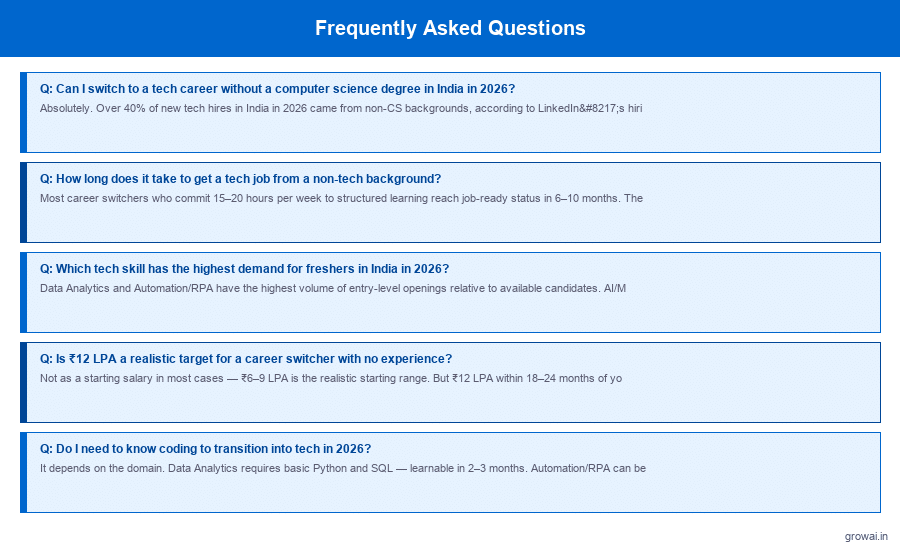
Can I switch to a tech career without a computer science degree in India in 2026?
Absolutely. Over 40% of new tech hires in India in 2026 came from non-CS backgrounds, according to LinkedIn’s hiring data. What companies assess is demonstrable skill and problem-solving ability — both of which you can build through structured learning programmes and a strong portfolio, regardless of your undergraduate degree.
How long does it take to get a tech job from a non-tech background?
Most career switchers who commit 15–20 hours per week to structured learning reach job-ready status in 6–10 months. The median time to first offer after starting active applications is 6–10 weeks. Total journey from “I’ve decided” to “I’m joining”: typically 8–12 months.
Which tech skill has the highest demand for freshers in India in 2026?
Data Analytics and Automation/RPA have the highest volume of entry-level openings relative to available candidates. AI/ML has high salaries but is more competitive. Web development has the most total openings but also the most candidates. For the best “demand vs. competition” ratio, Data Analytics is the strongest bet for most non-tech switchers.(Tech Career Transition Roadmap)
Is ₹12 LPA a realistic target for a career switcher with no experience?
Not as a starting salary in most cases — ₹6–9 LPA is the realistic starting range. But ₹12 LPA within 18–24 months of your first tech job is a very achievable milestone for someone who continues upskilling, takes on stretch projects, and is willing to change employers once for a salary step-up. It requires intention, not just tenure.
Do I need to know coding to transition into tech in 2026?
It depends on the domain. Data Analytics requires basic Python and SQL — learnable in 2–3 months. Automation/RPA can be done with minimal coding using tools like UiPath. Full web development or AI/ML requires more significant coding investment. No-code and low-code roles exist and are growing, but the ₹10 LPA+ ceiling is much more accessible with coding skills.(Tech Career Transition Roadmap)
Your Tech Career Starts With One Decision
First and foremost, the roadmap is clear. Moreover, the market is open. Furthermore, the tools are affordable. Therefore, the only thing between where you are today and a ₹12 LPA tech career is a sequence of concrete decisions executed consistently over the next 8–12 months.
To begin with, choose your domain this week. After that, enrol in a structured programme by the end of the month. Subsequently, build your first project before week six. Finally, apply before month six is over. As a result, every day you delay is a day your future self spends earning the same salary you are earning right now.
Most importantly, the people making this tech career transition roadmap journey aren’t smarter than you. In fact, they are not better connected either. However, they just decided — and then they did the work.
Conclusion
In conclusion, the best time to start your tech career transition roadmap is right now. Furthermore, India’s IT industry is growing faster than ever and companies are desperately looking for skilled freshers.
Therefore, follow this step-by-step guide, stay consistent for 6 months, and apply aggressively. Most importantly, the journey from ₹0 to ₹12 LPA is 100% possible — thousands of Indians have already done it.
Book a Free Demo at GrowAI

