

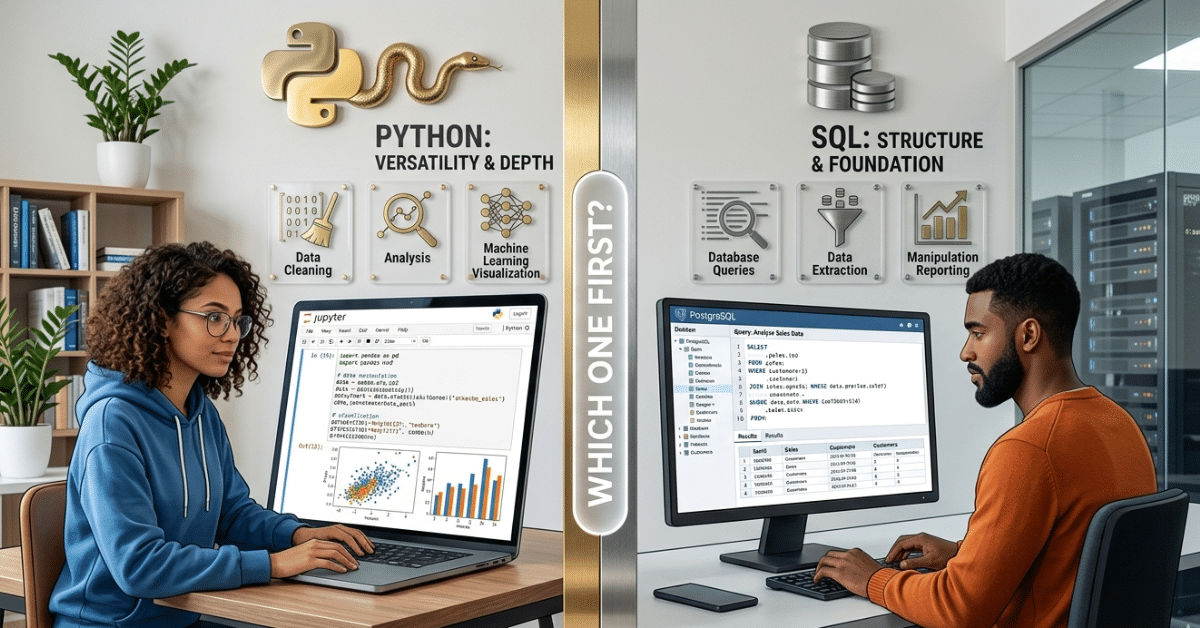
A complete comparative analysis of Python for data analytics vs SQL for data analytics — so you can make the right choice, save months of confusion, and launch your career faster.
This is one of the most Googled questions by data analytics beginners in 2026: Should I learn Python for data analytics first, or SQL for data analytics? The wrong choice doesn’t just waste time — it can kill motivation entirely. This guide gives you a clear, honest answer based on what employers actually hire for — with no jargon and no bias.
What Is SQL and Why Does It Matter for Data Analytics?
SQL stands for Structured Query Language. It is the language you use to talk to databases — and almost every company in the world stores its data in a database. Customer orders, website clicks, app usage, sales records, HR data — it all lives in tables, and SQL is how you pull exactly what you need.
When companies say they want a “data analyst,” what they almost always mean is: someone who can write SQL queries, clean and summarise data, and turn raw numbers into useful insights. SQL for data analysis is not optional — it is the core of the job.
What You Can Do With SQL for Data Analysis
- Extract specific data from massive databases in seconds using SELECT statements
- Filter, sort, and group records to find patterns (WHERE, GROUP BY, ORDER BY)
- Combine data from multiple tables with JOINs — one of the most used analyst skills
- Calculate totals, averages, counts with aggregate functions (SUM, AVG, COUNT)
- Identify trends over time using date functions and window functions
- Build the data sets that feed dashboards in Power BI and Tableau
Key fact: SQL appears in 95% of entry-level data analyst job listings in India. No other technical skill comes close. If you can write clean, efficient SQL, you are already hireable for a large chunk of the market.
What Is Python and How Is It Used in Data Analytics?
Python is a general-purpose programming language that has become the dominant tool for data science, machine learning, and advanced data analysis. For Python data analysis, you use specific libraries — Pandas for data manipulation, NumPy for numerical operations, Matplotlib and Seaborn for visualisation, and Scikit-learn for basic machine learning.
Python doesn’t just query databases — it can also clean messy data, automate repetitive tasks, create detailed visualisations, and build predictive models. This is why Python for data analytics is increasingly expected in more technical roles and at fast-growing tech companies.
What You Can Do With Python for Data Analysis
- Clean and reshape large, messy datasets using Pandas DataFrames
- Perform statistical analysis — correlations, regressions, hypothesis testing
- Automate reporting pipelines that previously required manual work
- Create rich, customised charts with Matplotlib and Seaborn
- Build basic machine learning models for prediction and classification
- Connect to APIs and scrape web data for analysis
Key fact: Python appears in 74% of data analyst job listings and virtually 100% of data scientist postings. It is the language of the modern data stack — and demand for Python data analysis skills is growing every year.
Python vs SQL for Data Analytics: Head-to-Head Comparison
Let’s put both side-by-side so you can see exactly where each one wins, where it falls short, and which is right for your situation right now.
| Factor | 🐍 Python | 🗄️ SQL |
|---|---|---|
| Ease of learning | Medium — requires programming mindset | Easy — reads like plain English |
| Time to job-ready | 3–5 months for solid basics | 4–6 weeks for solid basics |
| Job listing presence | 74% of analyst roles | 95% of analyst roles |
| Best for | Data science, ML, automation, custom analysis | Business analytics, reporting, BI dashboards |
| Works with | Jupyter, VS Code, APIs, ML frameworks | MySQL, PostgreSQL, BigQuery, Snowflake |
| Industry use | Tech, fintech, product analytics | Every industry, universally used |
| Salary premium | Higher (₹1–3 LPA extra) | Strong baseline |
| Interview frequency | High for technical roles | Almost universal — 95%+ interviews test SQL |
| Pair well with | SQL, Pandas, Tableau/Power BI | Python, Power BI, Excel |
“SQL gets you in the door. Python gets you promoted. But you need both to truly thrive in data analytics in 2026.”
When You Should Learn SQL for Data Analysis First
For most people — especially freshers starting from zero — learning SQL for data analysis first is the smarter choice. Here’s exactly who should prioritise SQL and why.
SQL First Makes Sense If You Are…
- A complete beginner with no prior coding or programming experience
- Looking to get hired as a data analyst within the next 3–4 months
- Targeting business analyst, reporting analyst, or BI developer roles
- Working in or aiming for industries like banking, FMCG, retail, or healthcare
- Preparing for data analyst interviews — SQL is tested in nearly every single one
- Planning to use Power BI or Tableau — SQL is how you feed data into these tools
Why SQL Is Easier to Start With
SQL reads almost like natural English. Consider: SELECT name, sales FROM customers WHERE city = ‘Mumbai’ ORDER BY sales DESC. Even a non-programmer can understand what this does immediately.
Compare that with setting up a Python environment, understanding data types, learning loops and functions — before you even touch data. SQL gets you doing real, useful work within days. Python takes weeks before you produce something meaningful.
- Week 1: SELECT, WHERE, ORDER BY — you’re already pulling real data
- Week 2: GROUP BY, aggregate functions — you can summarise datasets
- Week 3: JOINs — you can combine multiple tables like a pro
- Week 4–6: Window functions, subqueries — you’re interview-ready
When You Should Learn Python for Data Analysis First
There are specific situations where jumping into Python for data analysis right away makes strategic sense. Here’s who should consider Python first.
Python First Makes Sense If You Are…
- An engineer, developer, or computer science graduate with prior programming experience
- Aiming for data science or machine learning roles from the start
- Targeting tech-first companies — startups, fintech, product analytics teams
- Interested in automation and building data pipelines beyond just querying
- Planning to specialise in a Python-heavy domain like NLP, computer vision, or predictive analytics
Why the Best Strategy Is Learning Both Python and SQL Together
Here’s the truth that nobody says loudly enough: in a real data analytics job, you will use both Python for data analytics and SQL for data analytics every single week. They are not alternatives — they are partners.
SQL is for pulling and summarising data from databases. Python is for cleaning it, analysing it further, automating it, and visualising it in depth. The two tools hand off to each other constantly in professional data workflows.
A Real-World Analyst Workflow
- Step 1 (SQL): Write a query to extract the last 90 days of user transactions from the database
- Step 2 (Python — Pandas): Load the CSV into a DataFrame, clean missing values, standardise dates
- Step 3 (Python — Seaborn): Plot the distribution of transaction values and identify spending patterns
- Step 4 (SQL): Write a follow-up query to drill into the anomaly you spotted in step 3
- Step 5 (Power BI + SQL): Build a live dashboard connected to the database query
- Step 6 (Python — automation): Schedule a script that refreshes and emails the summary every Monday
The Smartest Learning Order for Freshers in 2026
Based on what Indian employers are actually hiring for, here is the learning sequence that gets you hired fastest — and sets you up for long-term growth:
- Month 1: SQL fundamentals (SELECT, JOINs, GROUP BY, aggregate functions)
- Month 2: Advanced SQL + Excel for business analysis
- Month 3: Python basics + Pandas + NumPy for data manipulation
- Month 4: Python visualisation (Matplotlib, Seaborn) + Power BI dashboards
- Month 5: Build 3–5 portfolio projects combining SQL + Python + Power BI
- Month 6: Interview prep, job applications, and real internship experience
Jobs and Salary: Python for Data Analytics vs SQL for Data Analytics
Your skill stack directly determines the roles you qualify for and the salary you can command. Here’s how the job market looks in 2026 for each combination.
| Role | SQL Required | Python Required |
|---|---|---|
| Data Analyst (General) | 95% of roles | 74% of roles |
| Business Analyst | Essential | Optional / Bonus |
| Marketing Analyst | Essential | 60% of roles |
| Product Analyst | Essential | Essential |
| Data Scientist | Essential | Essential |
| BI Developer | Essential | 25–40% of roles |
Why Smart Students Choose GrowAI to Learn Python & SQL Together
Stop the “which to learn first” confusion for good. GrowAI’s 3-month AI Data Analytics Course + Internship teaches you both Python and SQL — the right way, in the right order — with live mentors, real projects, and 100% placement guidance.
What Makes GrowAI Different from Other Data Analytics Courses?
There are dozens of online data analytics courses out there. So why are thousands of students choosing GrowAI as their launchpad? Here’s an honest comparison of what separates GrowAI from the crowd.
GrowAI Teaches Python and SQL Together — The Right Way
Most courses make you choose. GrowAI’s curriculum is built on the understanding that real-world data analysts need both Python for data analysis and SQL for data analysis. The program is sequenced so SQL builds your confidence first, and Python follows naturally — exactly as the best analysts learn in practice.
Live Mentors, Not Pre-Recorded Lectures
Watching videos alone doesn’t build career-ready skills. GrowAI’s 24 live interactive sessions mean you work through problems in real time with instructors who have genuine industry experience. When you’re confused about a SQL JOIN or a Pandas merge, you get an answer immediately — not three days later from a forum.
An Internship That Makes Your CV Real
A certificate is good. A certificate plus internship experience is what actually gets you shortlisted. GrowAI’s program includes a structured internship component so that when you walk into your first interview, your CV shows real project work — not just course completion.
Placement Guidance Until You Land the Job
GrowAI’s 100% technical placement guidance means the support doesn’t stop when the course ends. Resume review, interview prep, SQL mock tests, portfolio feedback — GrowAI keeps working with you until you are placed. That is a commitment most platforms simply don’t make.