

Manual Testing to Automation Testing: Complete Career Switch Guide India 2026
Making the switch from manual testing to automation testing in India in 2026? Manual QA engineers who add Selenium with Java or Playwright with Python to their skills see 60-80% salary increases within 12-18 months, jumping from Rs4-5 LPA to Rs8-12 LPA. This guide gives you the exact roadmap, timeline, and skills needed to make this transition successfully.
Why Manual Testers Must Switch to Automation in 2026
The QA job market in India is shifting rapidly. Here is what the data shows:
- Manual testing job postings declined 23% in 2024-25
- Automation testing roles grew 41% in the same period
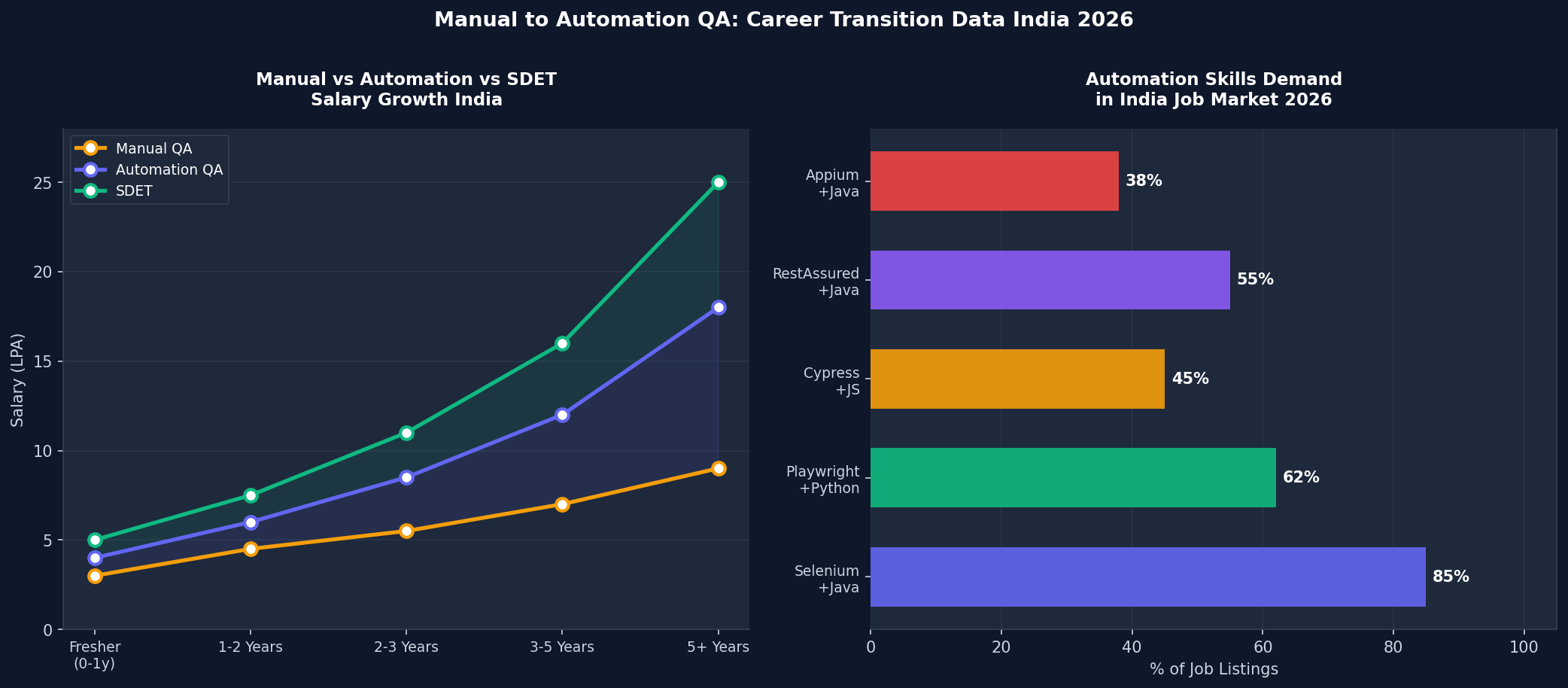
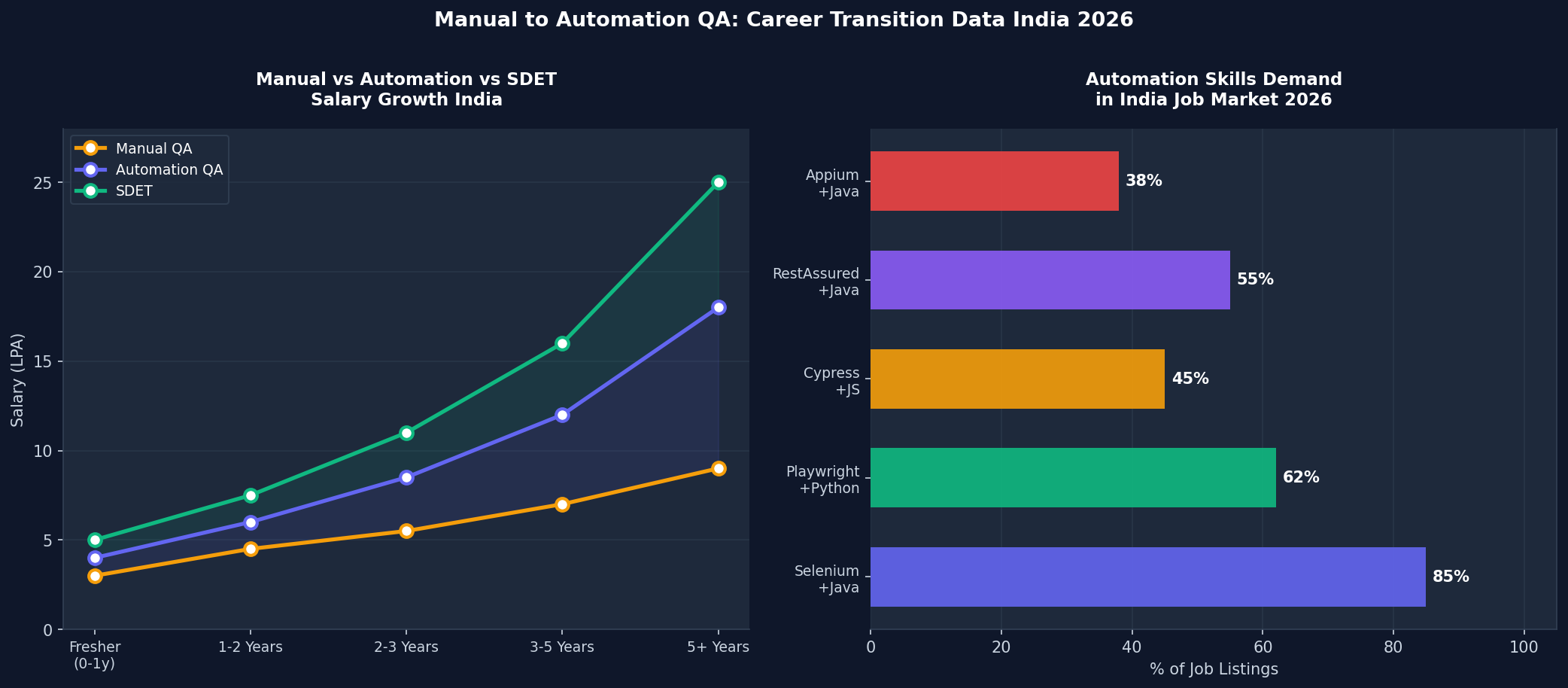
- Manual QA ceiling in India: Rs6-8 LPA after 5+ years
- Automation QA at 3 years experience: Rs10-14 LPA
- SDET roles (Senior Automation): Rs20-30 LPA at product companies
- 55% of QA teams report shortage of automation engineers
The shift is not about replacing manual testers — it is about evolution. Regression testing, smoke testing, and build validation are being automated. Manual testers who stay only manual will find their roles shrinking and salaries stagnant.
Manual Tester Advantage: What You Already Have
Many manual testers underestimate their existing skills. Before learning automation, recognize what you bring:
- Test case design: You understand equivalence partitioning, boundary value analysis, decision tables
- Bug mindset: You know how to think like a user and find edge cases
- Domain knowledge: Banking, e-commerce, healthcare — your industry knowledge is rare
- STLC knowledge: Sprint ceremonies, defect lifecycle, release cycles
- Tool familiarity: JIRA, TestRail, Confluence — tools automation engineers also use
Automation engineers who started as manual testers write better tests than developers who jumped straight to automation — because they understand what actually needs testing.
4-Month Transition Roadmap for Manual Testers
Month 1: Choose Your Stack and Learn Java/Python Basics
First decision: Selenium + Java (most jobs) or Playwright + Python (growing fast, higher salary). If you work in a traditional IT firm, choose Java. If you want startup roles or higher growth, choose Python.
- Java basics: variables, data types, loops, conditions (Week 1)
- OOP concepts: classes, objects, inheritance, interfaces (Week 2)
- Collections: ArrayList, HashMap, common string methods (Week 3)
- Exception handling, file I/O, basic Maven project setup (Week 4)
Month 2: Selenium WebDriver Core
- WebDriver setup: Chrome, Firefox, Edge drivers
- Locators: ID, name, XPath, CSS selector, link text (with practice)
- Actions: click, type, select dropdowns, handle alerts, file upload
- Waits: implicit, explicit (WebDriverWait + ExpectedConditions), fluent wait
- TestNG: @Test, @BeforeMethod, @AfterMethod, @DataProvider, XML suite
- Page Object Model: create one complete POM project for practice site
Month 3: Advanced Automation + API Testing
- Framework: TestNG + POM + Maven + ExtentReports (full working framework)
- Data-driven testing: Excel/CSV with Apache POI or OpenCSV
- Parallel execution: TestNG parallel="tests" or parallel="methods" config
- RestAssured basics: GET/POST/PUT/DELETE requests with JSON validation
- Postman collections: environment variables, pre-request scripts, assertions
- Git + GitHub: commits, branches, push, pull request (basic workflow)
Month 4: Portfolio + Job Applications
Portfolio is the difference between interviews and silence. Build these 3 projects:
- E-commerce test suite: Full Selenium + TestNG + POM framework for SauceDemo — login, cart, checkout, negative cases. 40+ test cases, parallel execution, ExtentReport.
- API automation suite: RestAssured + TestNG testing a public REST API (Petstore or ReqRes) — CRUD operations, schema validation, auth headers.
- Hybrid framework: Data-driven + keyword-driven hybrid, reading from Excel, screenshot on failure, CI pipeline with GitHub Actions.
Skills Comparison: What Changes vs What Stays Same
| Area | Manual Testing | Automation Testing |
|---|---|---|
| Test Design | Same techniques apply | Same — automated scripts implement these |
| Bug Reporting | JIRA, manual description | Same + screenshot on failure auto-attached |
| Execution | Manual step-by-step | Script runs, CI triggers, parallel execution |
| Coding | Not required | Java/Python – NEW skill to add |
| Framework | Not required | TestNG/Pytest/Playwright – NEW to learn |
| Salary Ceiling | Rs6-8 LPA (5+ years) | Rs18-30 LPA (5+ years SDET) |
Resume Transformation: Before and After
Before (Manual Tester Resume)
- 3 years manual testing experience in banking domain
- Test case writing, bug reporting, regression testing
- Tools: JIRA, TestRail, Postman (basic)
After (Automation Tester Resume)
- 3 years QA experience + Selenium Java automation (trained)
- Automation frameworks: TestNG + POM + Maven + ExtentReports
- API Testing: RestAssured, Postman (advanced collections, assertions)
- GitHub: 3 automation projects — links provided
- Banking domain expertise — can write better tests than pure developers
Where to Apply as a Transitioning Manual Tester
- LinkedIn: Search “QA Automation 1-3 years” — many companies accept manual testers with automation portfolio
- Naukri.com: Filter 1-3 years experience, QA Automation — target mid-size IT firms first
- Internal transfer: Check if your current company has automation team openings — existing domain knowledge is valued
- Target companies: Mphasis, Hexaware, Mindtree, Capgemini for automation roles at Rs6-9 LPA entry point
Common Interview Questions for Manual-to-Automation Switchers
- Why are you switching from manual to automation testing?
- Write a Selenium script to login to a website and verify dashboard elements.
- How do you decide what to automate vs keep manual?
- Explain your automation framework architecture.
- How do you handle test data in your automation suite?
- What is the difference between TestNG and JUnit?
- How do you integrate your automation suite with CI/CD?
- Walk me through debugging a flaky test.
Frequently Asked Questions
How long does it take a manual tester to switch to automation?
With 2-3 hours daily practice, manual testers typically make the switch in 4-6 months. Those with programming background move faster — 2-3 months. The key factor is daily consistent practice with real test code, not just watching tutorials.
Do I need to quit my job to learn automation testing?
No. Learn 2-3 hours daily after work. After Month 2, start applying. Most manual testers get automation interviews while still employed. Notice period is 1-2 months — enough time to prepare for joining.
Which is better: Selenium Java or Playwright Python for a manual tester in India?
Selenium Java has 85% of job postings and is safe for first automation job. Playwright Python is growing fast and pays Rs2-3 LPA more at product startups. If you are in a service company, start with Selenium Java. If targeting Bangalore/Pune startups, learn Playwright Python.
Will manual testing jobs disappear completely in India?
No, but they will shrink significantly. Manual testing will remain for exploratory testing, usability testing, and complex edge cases. However, routine regression and smoke testing will be 100% automated by 2027. Manual testers who do not upskill will face stagnant salaries and fewer opportunities.
Can a non-IT background manual tester switch to automation?
Yes. Many successful automation engineers started in non-IT domains — BBA, Science graduates, commerce backgrounds. Java and Python are learnable skills. The QA mindset from manual testing is harder to teach than coding.
