

Humanoid Robots in 2026: Tesla, Figure AI & What It Means for Your Job
In September 2024, Tesla’s Optimus robot independently sorted 100% of battery cells at a Gigafactory for an entire shift — without a human touching the controls. The age of humanoid robots in commercial production is not coming. It arrived.
This is not a concept video. It is not a research paper. It is a production floor, running right now, with robots that walk, adapt, learn, and outperform human workers on specific tasks. By 2026, three companies — Tesla, Figure AI, and 1X — are racing to deploy thousands of these machines across manufacturing, warehousing, elder care, and construction. The question is no longer “will humanoid robots change the workforce?” The question is: “Are you prepared for what comes next?”
TL;DR — What You Need to Know in 60 Seconds
- Tesla Optimus is already deployed inside Gigafactories performing real manufacturing tasks, with Elon Musk targeting commercial sales to manufacturers by late 2025 and consumers by 2026.
- Figure AI raised $675M, is live at BMW plants, and uses imitation learning so robots can be trained by demonstration — no coding required.
- 1X’s Neo robot (backed by OpenAI) targets elder care and assisted living — the first humanoid designed specifically for home and care environments.
- Humanoid robots generate massive volumes of sensor data — creating urgent, growing demand for data analysts, ML engineers, and AI professionals.
- The biggest career threat is not the robot. It is being unprepared to work alongside the data it produces.
What Makes Humanoid Robots Different From Regular Industrial Robots
Traditional industrial robots are extraordinary at doing one thing, in one place, with zero variation. A robotic welding arm at a Toyota plant can perform 1,200 identical welds per shift with sub-millimeter precision. But move it three feet to the left, change the part shape, or ask it to pick up a box — and it is useless. It has no concept of “the world.” It only knows its programmed path.
Humanoid robots are built on an entirely different premise. They are designed around what researchers now call Physical AI — artificial intelligence that understands the physical world. That means gravity. Friction. Spatial relationships. The difference in force required to pick up a ceramic mug versus a plastic bottle. The ability to navigate a corridor it has never seen before, step over a cable on the floor, and hand an object to a person without crushing their fingers.
This is powered by world models — internal simulations that allow a robot’s AI to predict what will happen before it happens. Instead of memorizing a fixed sequence of movements, a robot with a world model can reason: “If I grip here, the object will tilt. I should grip lower.” That is a fundamental shift from automation to intelligence.
Three additional capabilities separate humanoid robots from their predecessors:
- Mobility: Bipedal locomotion allows humanoid robots to operate in spaces built for humans — staircases, narrow aisles, loading docks, hospital corridors. No facility redesign required.
- Adaptability: When a task changes, a humanoid robot can adjust. Figure AI’s robots have been observed switching between different part-sorting tasks mid-shift as production line requirements changed.
- Learning from Demonstration: The most important capability of 2025-2026. A human worker demonstrates a task — folding a box, placing a component — and the robot observes, replicates, and refines. No engineer needed. No custom code. This is called imitation learning, and it compresses robot training from months to hours.
The combination of these capabilities — Physical AI, mobility, adaptability, and imitation learning — is why the humanoid robot market is projected to reach $38 billion by 2035, up from less than $2 billion in 2024, according to Goldman Sachs research.
The 3 Companies Defining Humanoid Robots in 2026
Tesla Optimus — The Manufacturing Giant’s Bet
Tesla has an advantage no other robotics company on earth has: it already builds some of the most sophisticated AI-powered machines in the world — cars. The neural networks, sensor fusion systems, and real-world training data pipelines that power Tesla’s Full Self-Driving technology are being directly applied to Optimus.
Optimus Gen 2 can walk at 30% faster speeds than its predecessor, has tactile sensing in its fingers capable of picking up eggs without breaking them, and operates for a full shift on a single charge. By mid-2025, Tesla had deployed Optimus units across its Fremont and Texas Gigafactories performing real production tasks: sorting battery cells, carrying components between stations, and loading parts onto assembly fixtures.
Elon Musk’s stated roadmap: sell to manufacturers first at a target price of $20,000–$25,000 per unit, then to consumers. At scale, he has projected production of 1 million Optimus units per year by 2030. Tesla’s vertical integration — building its own chips, training its own models, running its own factories as test environments — gives it a structural advantage that pure robotics startups cannot easily replicate.
Figure AI — The Imitation Learning Specialist
Figure AI was founded in 2022 and raised $675 million in a 2025 funding round that included Microsoft, OpenAI, Jeff Bezos, and NVIDIA. That is not a list of investors making a passive bet. Those are the exact companies whose infrastructure, AI models, and distribution networks Figure AI needs to scale.
Figure’s technical edge is its imitation learning pipeline. A human worker wears motion-capture gloves and performs a task. The robot watches. Within hours, it can replicate the task with sufficient accuracy to be deployed. This dramatically reduces the engineering overhead of introducing robots to new tasks — historically the single biggest bottleneck in commercial robot deployment.
Figure’s Figure 02 robot is currently live in BMW’s Spartanburg, South Carolina manufacturing facility — one of the most complex auto assembly plants in the world. Figure has also announced a partnership with Amazon to explore deployment in fulfillment centers, a market where even a 5% efficiency gain translates to hundreds of millions of dollars annually.
1X (Formerly Halodi Robotics) — The Neo for Human Spaces
1X is backed by a significant investment from OpenAI’s startup fund. 1X is building its Neo robot specifically for home and care environments — not factories. This is a deliberate and important distinction.
Neo is designed to be physically safe to operate near elderly or vulnerable people, and capable of handling unstructured domestic tasks: fetching items, assisting with mobility, monitoring health indicators. The elder care market in the United States alone is facing a projected shortfall of 3.2 million care workers by 2030. 1X is positioning Neo directly at that gap.
Free 2026 Career Roadmap PDF
The exact SQL + Python + Power BI path our students use to land Rs. 8-15 LPA data roles. Free download.
Tesla Optimus vs Figure AI vs 1X Neo — Head to Head
| Criteria | Tesla Optimus | Figure AI (Figure 02) | 1X Neo |
|---|---|---|---|
| Funding / Backing | Tesla internal (publicly traded) | $675M raised (2025); investors include OpenAI, Microsoft, NVIDIA, Bezos | OpenAI startup fund + undisclosed Series B |
| Deployment Status | Live in Fremont & Texas Gigafactories | Live at BMW Spartanburg; Amazon partnership announced | Pilot deployments in assisted living facilities |
| Primary Use Case | Manufacturing, heavy industry | Auto manufacturing, warehouse logistics | Elder care, assisted living, domestic tasks |
| AI Approach | Neural nets from FSD pipeline; end-to-end learning | Imitation learning from human demonstration | LLM-powered interaction + physical task learning |
| Production Target | 1 million units/year by 2030 (Musk projection) | Not publicly disclosed; BMW partnership ongoing | Focused on quality over volume; care-first design |
| Key Partner | Tesla Gigafactories (internal) | BMW, Amazon | OpenAI, undisclosed care home operators |
Where Humanoid Robots Are Being Deployed Right Now
Manufacturing
This is ground zero. Auto manufacturing plants — with their mix of repetitive tasks, heavy components, and demanding quality standards — are the ideal proving ground. BMW’s adoption of Figure AI robots is not a PR stunt. BMW’s Spartanburg plant produces over 1,500 vehicles per day. Any robot deployed there must meet aerospace-grade reliability standards. The fact that Figure’s robots are operating live in that environment is a proof point the entire industry is watching.
Warehousing and Logistics
Amazon’s U.S. fulfillment network employs over 750,000 people, many performing physically grueling pick-and-pack tasks with high injury rates. Humanoid robots represent the next tier — capable of handling the irregular, unpredictable tasks that wheeled platforms cannot. A humanoid can pick a single item from a mixed-SKU shelf, re-pack a damaged box, and navigate around a human co-worker without stopping the line.
Elder Care
The elder care labor crisis is not a future problem. It is happening today. Japan, South Korea, Germany, and the United States are all facing acute shortages of care workers. 1X’s Neo is targeting this with a robot designed from the ground up for human environments. Tasks like mobility assistance, medication reminders, vital sign monitoring, and companionship are within Neo’s roadmap.
Construction and Field Work
Construction sites are chaotic, unstructured, and physically demanding — exactly the environment where traditional robots fail completely. Humanoid robots capable of framing, drywall, and finishing work are the next frontier. Several DARPA-funded programs are actively testing humanoid performance in disaster response and field construction contexts.
How a Humanoid Robot Learns a New Task
START
↓
Task Demonstrated by Human (motion capture, VR gloves, or direct observation)
↓
Robot Observes (Imitation Learning — visual + kinematic data recorded)
↓
Simulation Training (thousands of virtual repetitions in physics engine)
↓
Real-World Fine-Tuning (limited supervised trials on actual hardware)
↓
Deployment (robot performs task in live environment)
↓
Sensor Data Collected (cameras, force sensors, joint encoders — gigabytes per shift)
↓
Model Updated (edge cases addressed, performance gaps corrected)
↓
Better Performance → Loop continues
Every single step in this loop generates data. Enormous volumes of it. And every dataset needs to be cleaned, labeled, analyzed, and fed back into the model — by humans who understand both the data and the domain.
Key Insights
- Humanoid robots are not replacing factories — they are replacing the specific tasks within factories that cause the most human injury and fatigue.
- The imitation learning breakthrough changes who can train robots from “ML engineers” to “any experienced worker.”
- Every humanoid robot deployed generates an estimated 2–10 GB of sensor data per operating shift. At 10,000 deployed units, that is up to 100 TB of raw data per day.
- The companies winning the humanoid race are the ones with the best data loops — not the best hardware. Tesla’s advantage is not Optimus’s motors. It is the billions of miles of real-world driving data that trained its AI systems.
- The $20,000–$25,000 target price for Optimus — if achieved — would make humanoid robots cheaper per year than hiring a minimum-wage worker in most U.S. states.
Case Study: Figure AI at BMW Spartanburg
The Challenge: BMW’s Spartanburg plant produces the X5, X6, and X7 SUVs. Body shop tasks — physically moving and placing large structural components — are among the most injury-prone jobs in the plant. Prior to the Figure AI pilot, these tasks required dedicated human workers performing highly repetitive motions across 8-hour shifts, with musculoskeletal injury rates significantly above industry average.
The Deployment: Beginning in 2024, BMW introduced Figure 02 robots into selected body shop stations. Workers demonstrated tasks using Figure’s imitation learning system. Robots were trained in simulation, validated in controlled trials, and deployed to live production stations. Human workers remained on-site to supervise and handle exceptions.
The Outcome: Figure AI confirmed in a 2025 investor update that their BMW deployment achieved:
- Sustained operation across full production shifts with uptime comparable to human workers
- Measurable reduction in repetitive strain injury incidents at deployed stations
- Task error rates within acceptable production tolerances from the first week of full deployment
- Human workers redeployed to higher-complexity, higher-value tasks rather than displaced from the plant
The BMW deployment did not reduce the plant’s human headcount. It changed what those humans do. Workers who were performing repetitive component placement are now performing quality inspection, exception handling, and robot supervision — jobs that require judgment, not just repetition.
4 Common Misconceptions About Humanoid Robots
Misconception 1: “Humanoid robots will replace all jobs overnight.”
Reality: Deployment is gradual, task-specific, and constrained by the robot’s ability to handle variability. Full replacement of a complex human role requires solving hundreds of sub-tasks reliably. The more accurate picture is role transformation — certain repetitive sub-tasks within a job are automated, while the human handles everything else. That process takes years per role, not months across all roles.
Misconception 2: “Humanoid robots are fully autonomous right now.”
Reality: Every humanoid robot currently in commercial deployment operates with significant human oversight. Robots flag exceptions, request human intervention, and operate within defined task parameters. Full autonomy across unstructured environments is a research goal, not a 2026 product reality.
Misconception 3: “Humanoid robots are only useful in factories.”
Reality: The factory-first deployment strategy is a pragmatic starting point. The actual target environment for humanoid robots — based on where the greatest labor shortfalls exist — is homes, care facilities, and construction sites. 1X is already in assisted living pilots. The factory phase is the training ground, not the final destination.
Misconception 4: “Humanoid robots are too expensive to be commercially real.”
Reality: At Tesla’s stated target of $20,000–$25,000 per unit, this is categorically false. A single human worker in the U.S. costs an employer $45,000–$75,000 per year in wages, benefits, and overhead. A robot at $25,000 with a five-year lifespan costs $5,000 per year before maintenance. The economics are already compelling at scale.
Frequently Asked Questions About Humanoid Robots in 2026
Will humanoid robots replace human jobs in 2026?
Not wholesale, and not overnight. Specific repetitive tasks — particularly in manufacturing and warehousing — are being automated right now. But complete job replacement requires robots to handle the full range of a role’s variability, which remains technically out of reach for most positions. The more immediate reality in 2026 is that job descriptions are changing, not disappearing.
Which companies are deploying humanoid robots?
The three leading commercial deployments are Tesla (Optimus in its own Gigafactories), Figure AI (Figure 02 at BMW Spartanburg and an announced Amazon partnership), and 1X (Neo in assisted living pilot programs). Additional programs are active at Agility Robotics, Apptronik, and Sanctuary AI.
What is Physical AI and why does it matter for robots?
Physical AI refers to artificial intelligence that understands how the physical world works — gravity, friction, object permanence, spatial relationships. It allows a robot to pick up an unfamiliar object without dropping it, or navigate a new environment without pre-mapped routes. Without Physical AI, robots are expensive, single-purpose machines. With it, they become general-purpose tools.
What jobs are safe from humanoid robot automation?
Roles requiring complex judgment, emotional intelligence, creative problem-solving, and interpersonal trust are the most durable. Data analysts, ML engineers, software developers, healthcare diagnosticians, educators, therapists, and senior managers are not facing imminent displacement. The rise of humanoid robots is actively creating new demand for data and AI professionals who can manage the data these robots generate.
How much does a humanoid robot cost in 2026?
Current commercial-grade humanoid robots range from $70,000 to $250,000 per unit depending on capability and manufacturer. Tesla has publicly targeted a consumer price of $20,000–$25,000 for Optimus at scale. Whether that price point is achieved by 2026 or 2028 depends on production volume, component costs, and manufacturing efficiency.
The Real Opportunity Nobody Is Talking About
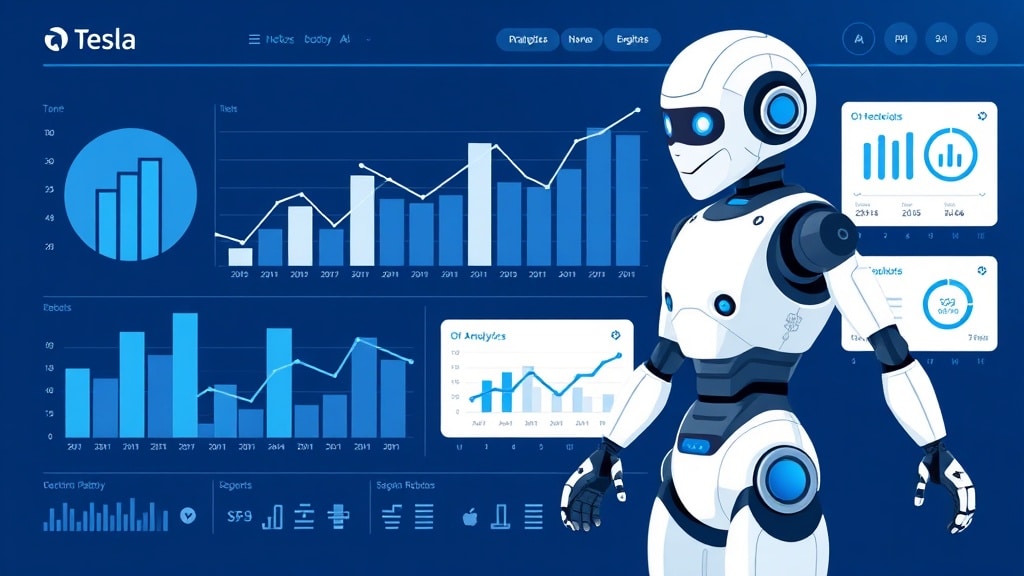
Here is what the mainstream conversation about humanoid robots almost always misses: every robot deployed is a data-generating machine running around the clock.
A single humanoid robot on a factory floor streams data from joint encoders, force-torque sensors, stereo cameras, depth sensors, and IMUs continuously. That data is used to retrain models, flag mechanical issues before failures occur, optimize task performance, and plan the next generation of hardware. At 1,000 deployed robots, that is a river of data. At 100,000 deployed robots — Tesla’s target within this decade — that is an ocean.
Someone has to manage that ocean. Someone has to build the pipelines, train the models, monitor the dashboards, and translate the sensor telemetry into business decisions. That someone is a data analyst. An ML engineer. An AI specialist.
The professionals who will thrive in the humanoid robot economy are not the ones trying to outrun the automation. They are the ones who learn to read the data the robots produce — and turn it into strategic decisions.
If you are ready to position yourself in that category, GROWAI’s Data Analytics Course is built for exactly this moment. You will learn to work with real-world datasets, build the analytical frameworks that robot operations require, and develop the skills that every company deploying humanoid robots is actively hiring for right now.
The robots are already on the factory floor. The question is which side of the data you will be on.

