

Data Analytics Interview Preparation: 30 Questions You Must Know India 2026
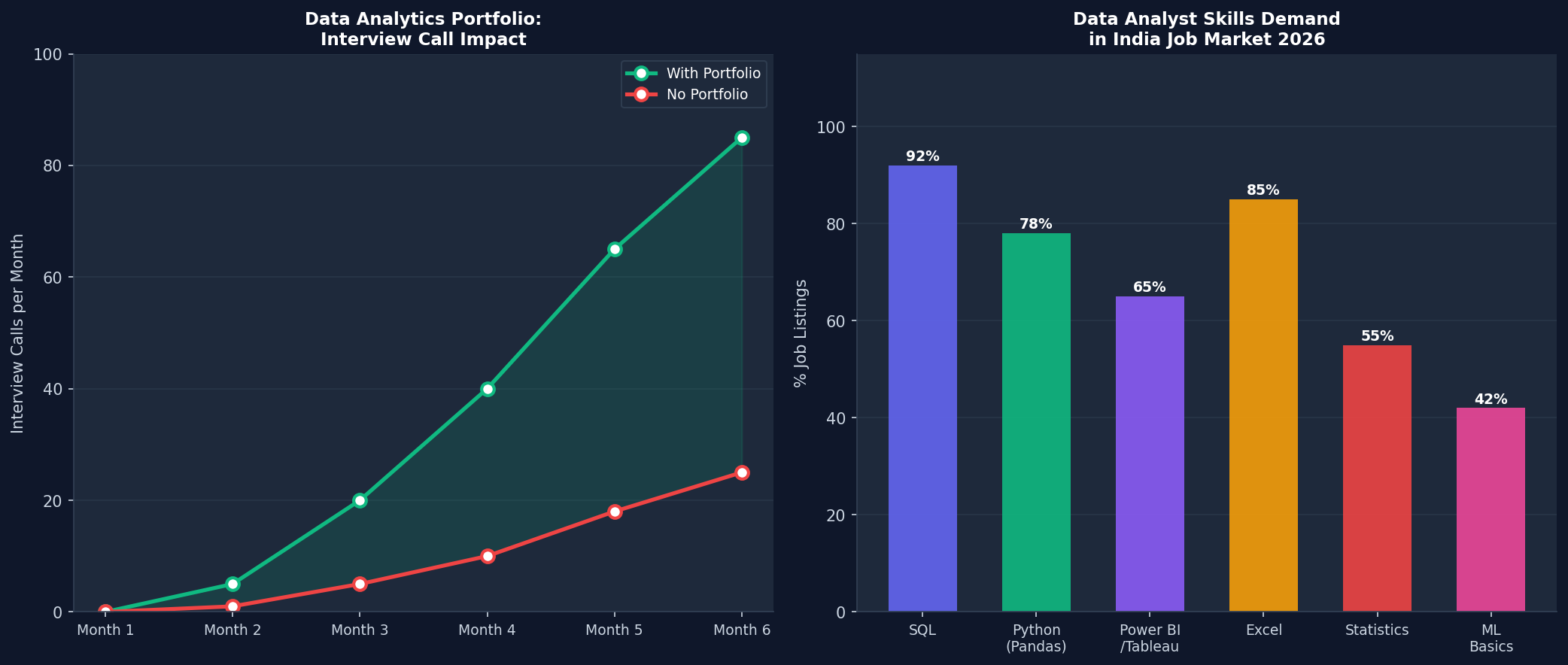
Preparing for a data analyst interview in India? 80% of DA interviews in India include a live SQL test, 65% ask you to walk through a dashboard you built, and 55% test Python data manipulation skills — knowing which questions to expect and how to answer them is half the battle. This guide covers the 30 most asked questions across SQL, Python, statistics, and business thinking.
SQL Interview Questions (Asked in 80% of DA Interviews)
Q1: What is the difference between INNER JOIN, LEFT JOIN, and FULL OUTER JOIN?
Answer: INNER JOIN returns only rows with matching values in both tables. LEFT JOIN returns all rows from the left table and matching rows from the right (NULLs where no match). FULL OUTER JOIN returns all rows from both tables with NULLs where no match exists.
Q2: Write a query to find the second highest salary in an Employee table.
-- Method 1: Using LIMIT/OFFSET
SELECT salary FROM Employee
ORDER BY salary DESC
LIMIT 1 OFFSET 1;

-- Method 2: Using subquery (more portable)
SELECT MAX(salary) FROM Employee
WHERE salary < (SELECT MAX(salary) FROM Employee);

-- Method 3: Window function (best answer to impress)
SELECT salary FROM (
    SELECT salary, DENSE_RANK() OVER (ORDER BY salary DESC) as rnk
    FROM Employee
) ranked WHERE rnk = 2;
Q3: What is a window function? Give an example.
Answer: Window functions perform calculations across a set of rows related to the current row without collapsing them. Unlike GROUP BY, they preserve individual rows.
-- Running total of sales by month
SELECT
    order_date,
    sales,
    SUM(sales) OVER (ORDER BY order_date) as running_total,
    AVG(sales) OVER (PARTITION BY MONTH(order_date)) as monthly_avg
FROM orders;
Q4: How do you find duplicate records in a table?
SELECT email, COUNT(*) as count
FROM customers
GROUP BY email
HAVING COUNT(*) > 1;
Q5: What is a CTE and when would you use it?
Answer: CTE (Common Table Expression) is a named temporary result set defined with WITH clause. Use it to break complex queries into readable steps, replace subqueries, or create recursive queries.
Python/Pandas Questions (Asked in 55% of DA Interviews)
Q6: How do you handle missing values in a Pandas DataFrame?
df.isnull().sum()              # Count missing per column
df.dropna()                    # Remove rows with any NaN
df.fillna(df.mean())          # Fill with column mean
df['col'].fillna('Unknown')   # Fill categorical with placeholder
df.fillna(method='ffill')     # Forward fill (time series)
Q7: How do you merge two DataFrames in Pandas?
# SQL-equivalent JOINs
pd.merge(df1, df2, on='customer_id', how='inner')  # INNER JOIN
pd.merge(df1, df2, on='customer_id', how='left')   # LEFT JOIN

# Join on different column names
pd.merge(df1, df2, left_on='cust_id', right_on='customer_id')
Q8: How do you calculate month-over-month growth in Python?
df['MoM_Growth'] = df['Revenue'].pct_change() * 100
# For specific time grouping
monthly = df.groupby(df['Date'].dt.to_period('M'))['Revenue'].sum()
monthly_growth = monthly.pct_change() * 100
Statistics Questions (Asked at Consulting and Fintech Firms)
Q9: What is the difference between mean, median, and mode? When to use each?
Answer: Mean for symmetric distributions without outliers. Median for skewed distributions or data with outliers (like income data — one billionaire skews the mean). Mode for categorical data (most common product category). In India salary analysis, always report median — a few high-salary outliers make the mean misleading.
Q10: Explain A/B testing in simple terms.
Answer: A/B testing shows version A to half your users and version B to the other half simultaneously. You measure which performs better on your target metric (conversion rate, click-through rate) and use statistical tests to confirm the difference is real, not random chance. In India: Flipkart uses A/B testing for every UI change before rolling it out to all users.
Business Thinking Questions (Asked in 90% of DA Interviews)
Q11: How would you analyze why sales dropped 20% last month?
Answer framework: (1) Segment the drop — by product, region, customer type, channel. (2) Check for external factors — holiday, competitor campaign, supply issue. (3) Compare with same period last year (YoY). (4) Identify the specific segment driving the drop. (5) Propose hypothesis: is it acquisition (fewer new customers) or retention (existing customers buying less)? Present findings as: “Sales dropped 20% — concentrated in Electronics category in South India, which declined 42%. Other categories were flat. Hypothesis: competitor launched 30% discount campaign in this region on March 15.”
Q12: What metrics would you track for an e-commerce company?
Answer: Revenue metrics: GMV, Net Revenue, AOV (Average Order Value). Customer metrics: DAU/MAU, Retention Rate, Churn Rate, LTV. Operations: Fulfillment Rate, Return Rate, NPS. Growth: New User Acquisition, CAC (Customer Acquisition Cost), CAC:LTV ratio.
Top 18 More DA Interview Questions
- What is the difference between a fact table and a dimension table in a data warehouse?
- How do you detect and handle outliers in data?
- Explain the difference between correlation and causation with a business example.
- How do you validate data quality in a dataset you receive?
- What is a pivot table and when would you use one in analysis?
- How would you design a dashboard for a CEO vs a marketing manager?
- What is the difference between OLAP and OLTP databases?
- How do you present conflicting data findings to stakeholders?
- What is data normalization and why does it matter?
- Explain cohort analysis with a business example.
- How do you calculate customer churn rate?
- What is the difference between structured and unstructured data?
- How would you improve a dashboard that stakeholders say is “confusing”?
- What tools would you use to analyze 10 million rows of transaction data?
- Explain regression analysis to a non-technical manager.
- How do you prioritize which analysis to do first when you have multiple requests?
- What is data governance and why does it matter?
- Walk me through a complete analysis project you did — from data to decision.
Frequently Asked Questions
How long is a typical data analyst interview process in India?
Most Indian companies have 3-4 interview rounds: Resume screening and HR call (30 min), SQL live test (45-60 min), Technical interview with case study (60-90 min), and final HR/culture fit (30 min). Total process takes 2-3 weeks. Global MNCs like Amazon and Google have 5-6 rounds including a business case presentation.
Is live SQL coding asked in DA interviews even for freshers?
Yes — 80% of companies test SQL even for fresher roles. The questions are typically basic to intermediate: SELECT with JOINs, GROUP BY, aggregation, simple subqueries. Freshers who practice 50+ SQL problems on LeetCode or HackerRank are well prepared. Advanced window functions are asked at senior roles and consulting firms.
