


The top 10 AI tools used in data analytics in 2026 have completely transformed how analysts work. At GROWAI, we keep our curriculum updated with exactly these tools — so you learn what the industry actually uses, not what was popular five years ago.
Data analytics has changed dramatically in the last few years. And in 2026, AI tools are at the center of that change. In this guide, we have rounded up the top 10 AI tools used in data analytics in 2026 — tools being used by data analysts at top companies right now.
In this guide, we have rounded up the top 10 AI tools used in data analytics in 2026. These are tools that real professionals are using every day to clean data, build dashboards, predict trends, and make smarter decisions.
Let’s dive in
Why AI Tools Are Transforming Data Analytics in 2026
Before we jump into the list, let’s quickly understand why AI tools have become so important in data analytics.
Traditional data analytics relied heavily on manual processes; writing SQL queries, building pivot tables, and spending hours cleaning messy datasets. It worked, but it was slow.
Today, AI tools can:
- Automate repetitive data cleaning tasks
- Detect patterns in large datasets in seconds
- Generate charts and reports without writing a single line of code
- Predict future trends using historical data
- Answer complex data questions in plain English
This is why more companies from small businesses to multinational enterprises are investing heavily in AI tools for data analytics. The productivity gains are just too big to ignore.
How AI Is Changing the Role of Data Analysts?
Data analysts today spend less time on manual number-crunching and more time on strategy and interpretation. AI tools handle the heavy lifting, so analysts can focus on what matters, turning insights into action.
This shift is also making data analytics more accessible. You do not need to be a coding expert to use many of today’s top AI tools. Natural language interfaces, drag-and-drop dashboards, and automated reports mean that even non-technical teams can work with data confidently.
Top 10 AI Tools for Data Analytics in 2026
Here are the 10 best AI tools for data analytics that professionals are using right now. We have included a mix of tools for different needs, from beginner-friendly platforms to advanced machine learning environments.
1. Microsoft Copilot for Power BI
Microsoft Copilot has become one of the most widely used AI tools in data analytics, especially for business users already working within the Microsoft ecosystem.
What makes it stand out in 2026 is its deep integration with Power BI. You can now ask questions about your data in plain English and get instant visualizations, summaries, and recommendations.
Key features:
- Natural language querying, just type your question
- Automatic report generation from raw data
- AI-powered anomaly detection in dashboards
- Works seamlessly with Excel, Teams, and SharePoint
Best for: Business analysts, non-technical teams, and enterprises using Microsoft 365.
2. Tableau with Einstein Copilot
Tableau has long been a leader in data visualization, and its AI-powered layer — Einstein Copilot — makes it one of the top AI tools for data analytics in 2026.
Salesforce’s Einstein AI brings smart recommendations, predictive analytics, and automated insights directly into the Tableau interface. You get beautiful dashboards AND intelligent analysis, all in one platform.
Key features:
- AI-generated chart recommendations
- Predictive forecasting built into dashboards
- Automated data storytelling and narrative summaries
- Connects with Salesforce CRM data out of the box
Best for: Data analysts in sales-driven organizations and teams who need polished visual reports.
3. Google Looker with Gemini AI
Google Looker has always been powerful for business intelligence, but the integration of Gemini AI in 2025-2026 has taken it to a new level.
Gemini AI within Looker allows users to ask complex data questions, get summarized insights, and even have data automatically explained in readable language. It is one of the best AI tools for teams working in Google Cloud environments.
Key features:
- Conversational data exploration with Gemini
- Auto-generated explanations for dashboards
- Real-time data analysis with BigQuery integration
- Multi-cloud support and enterprise-grade security
Best for: Data teams using Google Cloud, marketing analysts, and organizations needing real-time analytics.
4. DataRobot
If your team needs to build machine learning models without a dedicated data science team, DataRobot is one of the most powerful AI tools available for data analytics in 2026.
It automates the end-to-end machine learning process, from data ingestion to model deployment. This is what is known as AutoML, and DataRobot is one of the best platforms for it.
Key features:
- Automated machine learning (AutoML) with minimal coding
- Explainable AI; understand why models make decisions
- Model monitoring and drift detection
- Connects with major data warehouses like Snowflake and Databricks
Best for: Business analysts and data scientists who want to build ML models faster.
5. Amazon QuickSight with Q (Generative BI)
Amazon QuickSight’s Q feature is a game changer for generative business intelligence. It lets users type a question in natural language and instantly receive a visual answer, no SQL required.
In 2026, AWS has expanded Q’s capabilities significantly, making QuickSight one of the top AI tools for data analytics for cloud-first teams.
Key features:
- Natural language Q&A for instant visualizations
- AI-generated executive summaries and narratives
- Serverless architecture, scales automatically
- Deep integration with AWS data services like S3, Redshift, and Athena
Best for: Teams already on AWS infrastructure and organizations looking for scalable, cost-effective analytics.
6. ThoughtSpot
ThoughtSpot is a pioneer in search-driven analytics and continues to be one of the leading AI tools for data analytics in 2026. Its Sage AI feature, powered by large language models, allows anyone in your team to get answers from data just by searching.
Think of it like Google Search, but for your company’s data.
Key features:
- AI-powered search bar for instant data answers
- Automated Liveboards that update in real time
- Natural language generation for reports and summaries
- Works with Snowflake, BigQuery, Redshift, and more
Best for: Non-technical business users who want self-service analytics without depending on IT or data teams.
7. IBM Watson Studio
IBM Watson Studio remains one of the most comprehensive AI tools for data analytics in enterprise environments. It is a full-featured platform for building, training, and deploying AI and machine learning models at scale.
In 2026, Watson Studio has expanded its AutoAI capabilities, making it easier to run experiments and find the best models automatically.
Key features:
- AutoAI for automated model building and selection
- Jupyter Notebook integration for custom coding
- Built-in data governance and bias detection
- Supports Python, R, and Scala
Best for: Enterprise data science teams, regulated industries (banking, healthcare), and organizations needing AI governance.
8. Databricks with AI/BI Genie
Databricks has rapidly grown into one of the most important platforms in the data and AI space, and its AI/BI Genie feature makes it a strong contender in the top 10 AI tools for data analytics in 2026.
Genie allows business users to interact with data using conversational AI, while data engineers and scientists use the underlying Databricks platform for large-scale processing.
Key features:
- Conversational analytics with Genie
- Unity Catalog for centralized data governance
- MLflow integration for experiment tracking
- Supports real-time streaming data analytics
Best for: Data engineering teams, large enterprises, and organizations handling big data at scale.
9. Notion AI for Data Documentation
This one might surprise you, but Notion AI has become a surprisingly useful tool in the data analytics workflow, especially for documentation, reporting, and knowledge management.
Data teams use Notion AI to write data dictionaries, summarize analysis results, create reports from notes, and keep stakeholders aligned without spending hours writing.
Key features:
- AI writing assistant for data reports and summaries
- Auto-summarize meeting notes and analytics findings
- Create structured templates for recurring reports
- Integrates with Slack, Jira, and Google Drive
Best for: Data analysts and product teams who need to communicate insights clearly and efficiently.
10. Julius AI
Julius AI is one of the newer but most exciting AI tools for data analytics in 2026. It works like a personal data analyst, you upload your data file (CSV, Excel, etc.) and simply chat with it in plain English.
Julius can clean data, run statistical analysis, create charts, and even write code to perform complex operations all through a simple chat interface.
Key features:
- Upload and chat with your data directly
- Instant chart and graph generation
- Statistical analysis without writing formulas
- Python code generation for advanced users
Best for: Students, individual analysts, freelancers, and anyone who wants a quick and easy way to explore data.
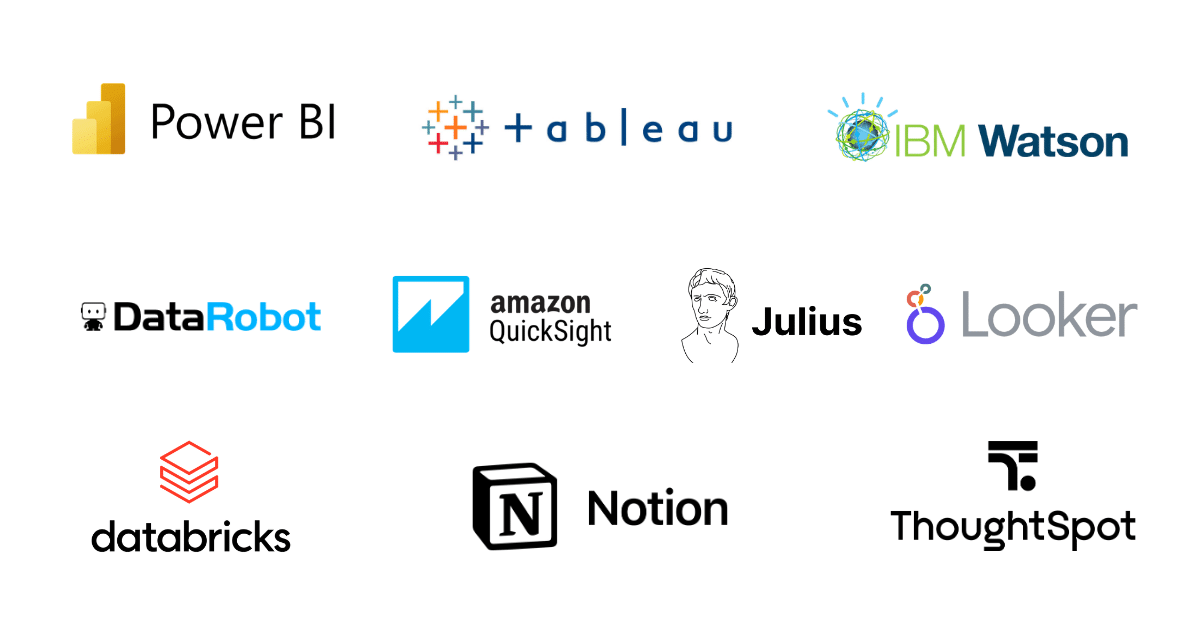
Quick Comparison: Top 10 AI Tools for Data Analytics
Which Tool Is Right for You?
Choosing the best AI tool depends on your team size, technical skills, and the type of data work you do. Here is a simple breakdown:
- For business users with no coding skills: Microsoft Copilot for Power BI, ThoughtSpot, Amazon QuickSight Q
- For data analysts who want visualization: Tableau with Einstein Copilot, Google Looker with Gemini
- For machine learning and predictive analytics: DataRobot, IBM Watson Studio, Databricks
- For quick individual data analysis: Julius AI
- For documentation and reporting: Notion AI
Tips for Choosing the Right AI Tools for Data Analytics
What to Look for in an AI Analytics Tool
With so many options available, how do you pick the right one? Here are a few things to consider:
- Ease of Use: Can your team use it without weeks of training? Look for tools with intuitive interfaces and natural language features.
- Integration: Make sure the tool connects with your existing data sources; your CRM, cloud storage, databases, or spreadsheets.
- Scalability: Will it still work well as your data grows? Enterprise tools like Databricks and IBM Watson are built for scale, while Julius AI is better for smaller datasets.
- Cost: Most of these tools offer tiered pricing. Some like Looker and Databricks can get expensive at scale, while others like Julius AI offer very affordable plans.
- Support and Community: A strong user community and documentation can save you a lot of time when you get stuck. Tableau, Power BI, and Databricks all have large, active communities.
The Future of AI Tools in Data Analytics
What to Expect in the Next Few Years
AI tools in data analytics are evolving faster than ever. Here are a few trends to watch:
- Agentic AI: Tools that can automatically run end-to-end data analysis tasks without human instruction
- Multimodal analytics: AI that can process text, images, audio, and structured data together
- Real-time AI insights: Moving from batch reporting to instant, always-on analytics
- Democratization of data: AI making advanced analytics accessible to every employee, not just specialists
- Tighter data governance: As AI analyzes more sensitive data, expect stricter privacy and compliance controls
The companies that embrace these AI tools today will have a significant advantage as the technology matures. The gap between data-driven organizations and those that aren’t is only going to grow.
Data analysts who don’t use AI will be left behind. Don’t be one of them.
FAQ: AI Tools in Data Analytics
1. What are AI tools in data analytics?
AI tools in data analytics are software platforms that use artificial intelligence; including machine learning, natural language processing, and automation to help users collect, clean, analyze, and visualize data. They reduce manual work and help uncover insights faster than traditional methods.
2. Which is the best AI tool for data analytics in 2026?
There is no single best tool, it depends on your needs. For business users, Microsoft Copilot for Power BI and ThoughtSpot are excellent choices. For data scientists and engineers, DataRobot and Databricks offer more advanced capabilities. Julius AI is great for quick individual analysis.
3. Can non-technical people use AI tools for data analytics?
Absolutely. Many of the top AI tools in this lis; like Julius AI, ThoughtSpot, and Amazon QuickSight Q are designed specifically for users without a technical background. You can ask questions in plain English and get instant answers from your data.
Still learning outdated analytics tools?
Final Thoughts
The world of data analytics is changing fast, and AI tools are leading the charge. Whether you are an individual analyst looking to work smarter or a large enterprise trying to scale your data capabilities, there is an AI tool on this list for you.
From Microsoft Copilot for Power BI to Julius AI, the top 10 AI tools for data analytics in 2026 cover every use case visualization, machine learning, natural language querying, and everything in between.
The best time to start exploring these tools is right now. Pick one that fits your team’s needs, try the free trial, and see how much faster and smarter your data work can become.
Data is only as powerful as the insights you pull from it. Let AI help you pull better insights faster.